


100 Years Ago: 1925 Solar Eclipse Disappoints Alton Residents

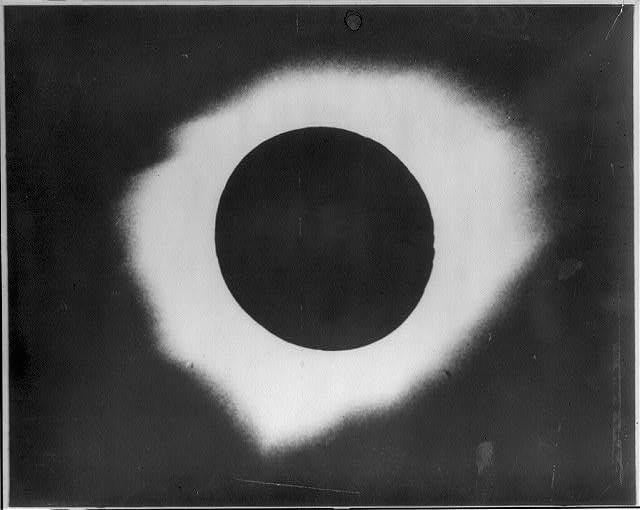
On January 24, 1925, the moon eclipsed the sun. In Alton, the eastern skies were partly cloudy, but the sun broke through the clouds just after 8 a.m., right when the eclipse here was at its peak. With a totality of 86% in Alton, a crescent was still visible, and some residents expressed their disappointment that it was not truly dark. “Daylight came as usual, and the light was better at time of greatest totality than on many recent mornings when a heavy haze has shrouded the early rays of the sun.”
Get The Latest News!
Don't miss our top stories and need-to-know news everyday in your inbox.
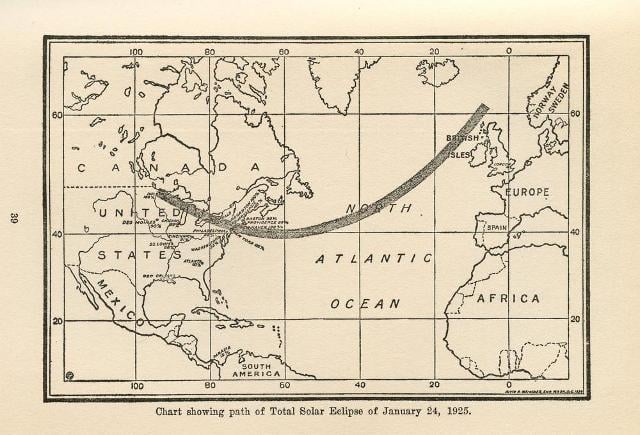
Altonians viewed a partial eclipse, but parts of Minnesota, Wisconsin, Michigan, Pennsylvania, New York, Connecticut, Massachusetts and Rhode Island experienced totality. New York and New England saw the eclipse under ideal conditions, but in Michigan and Ontario, clouds and low visibility made it difficult to observe. In New York City, “was the spectacle magnificent. When the moment arrived and a blackness of midnight at 9:11 a.m. was accompanied by the beautiful sight of the corona, there was enthusiasm. Watchers on skyscrapers and hill tops applauded and cheered.” The band of totality measured 103 miles wide, and only half of Manhattan could see the total eclipse. The boundary had been predicted to be 83rd Street, but ended up being 96th Street, so it wasn’t magnificent for everyone.
Despite the best scientific calculations, the actual time of the eclipse averaged four seconds later than astronomers had calculated: it was five seconds behind at Cornell, three seconds at Vassar, and five seconds at Yale. Scientists encouraged photographers and artists in the eclipse’s path to record their observations. Prof. Edwin B. Frost, director of the Yerkes Observatory at the University of Chicago, had very specific instructions for how to contribute to the scientific knowledge. “Photographers, amateur and professional, are urged to photograph the corona (the luminous envelope of the sun). If the camera is focused so that it gives a sharp picture of the moon or of objects as distant as 1,000 feet it will suffice and both short and long exposures should be made…it is [also] recommended that experts with the brush, living in the zone where the eclipse will be total, should have their colors ready at this eclipse and make a record of their impression of the corona. Persons skillful in drawing should make a sketch showing the size and shape of the corona. To save time, a circle about two inches in diameter should be drawn in advance, to represent the outline of the black moon exactly covering the sun, and then the sketch should be made to scale.”
One interesting article printed in the Alton Evening Telegraph the day before the 1925 eclipse recounted experiences of the 1869 eclipse by Upper Alton residents. Newspapers around the country printed information about the eclipse, but not everyone had access to the paper, so many people did not realize it was going to happen at all. For them, the experience was very scary. D.M. Kittinger, who was a child at the time of the 1869 eclipse, had been swimming in Wood River with several friends. They were on their way home when darkness fell. The boys were terrified and ran all the way home. George Nevlin was returning from an errand and was driving a horse (and presumably a wagon or carriage). When the eclipse was total, he unhitched the horse and raced to his parents' house on horseback. When he arrived, no one was home. He found his mother at a neighbor’s house with other residents of the neighborhood. They were all down on their knees praying.
Sources
Carter, Jamie. “99 Years Ago Today, A Total Solar Eclipse Split A Major U.S. City—And History Will Repeat Itself In 75 Days.” Forbes, Jan 24, 2024.https://www.forbes.com/sites/jamiecartereurope/2024/01/24/99-years-ago-today-a-total-solar-eclipse-split-a-major-us-city-and-history-will-repeat-itself-in-75-days/
“Corona - eclipse, 1/24/25.” United States of America, 1925. [Place of Publication Not Identified: Publisher Not Identified] Photograph. Library of Congress, Prints & Photographs Division, LC-USZ62-44253https://www.loc.gov/pictures/item/2007680838/
“Eclipse Seen Under Ideal Conditions in East; Alton Views it Almost at Crest.” Alton Evening Telegraph (Alton, IL), January 24, 1925.
“Eclipse of Sun Saturday; How it Affect Laymen, and Where it Will Be Visible.” Alton Evening Telegraph (Alton, IL), January 23, 1925.
“General Interest Manifest In Eclipse this Morning.” Alton Evening Telegraph (Alton, IL), January 24, 1925.
“Sees Little Chance for Alton to View Eclipse of the Sun on Jan. 21 [sic].” Alton Evening Telegraph (Alton, IL), January 16, 1925.
“Total Eclipse January 24.” Alton Evening Telegraph (Alton, IL), January 14, 1925.
“Upper Alton – Recollections of 1869 Eclipse by Upper Alton Men.” Alton Evening Telegraph (Alton, IL), January 23, 1925.
“Urges Amateurs to Take Photographs of Eclipse of the Sun on Saturday.” Alton Evening Telegraph (Alton, IL), January 22, 1925.
More like this:
- Most Popular


- Top Stories



- Most Recent



- Sign In
- Home
- Video
- News
-
Weather
 Sponsored by Michael Ryan Exteriors - Roofing Professionals
 - Sports
- Obits
- Events
- Radio
- AP News
- Shop Local
- Classifieds
- Autos
- Real Estate
- Directory
Get the RiverBender App


Follow Us
Copyright © 2026 RiverBender.com All rights reserved.
primary