


Keep An Eye On Diabetic Retinopathy
Over 30 million Americans suffer from diabetes, many unaware they have the condition leading to sight-threatening retinopathy complications.
 Key Takeaways:
- Diabetic retinopathy is a complication of diabetes that affects the back of the eye and can cause vision loss, blurry vision and other problems.
- More than 30 million people in the U.S. have diabetes and one-third don't even realize it.
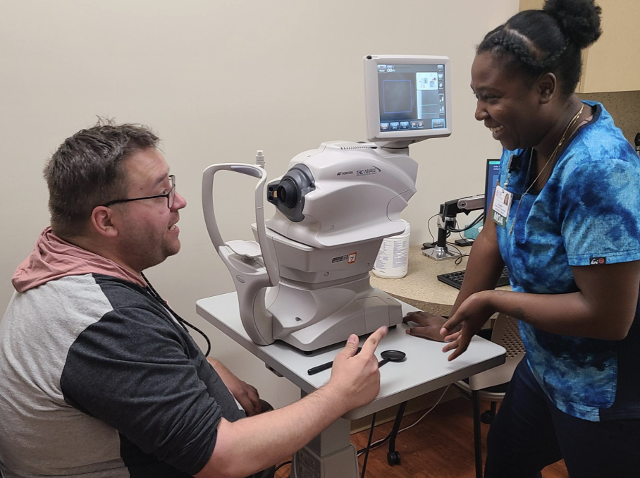
- OSF HealthCare has cameras at several locations that are used to detect retinopathy during a patient visit.
- Patients with diabetes should undergo an eye exam at least once a year.
Andrew Hade was diagnosed with diabetes two years ago. While the Rockford, Illinois, resident was surprised, he was more shocked when he later found out he also has diabetic retinopathy.
“Retinopathy is a complication of diabetes that affects the back of the eye and can cause vision loss, blurry vision and other complications,” says Pamela Garcia, a nurse practitioner for OSF HealthCare.
Garcia adds that early symptoms of retinopathy include floaters, blurriness, dark areas of vision and difficulty perceiving colors. Mild cases may be treated with diabetes management and more serious cases could require surgery.
It's important for people with diabetes to schedule a thorough eye exam at least once a year. That’s because most patients, like Hade, display no symptoms of diabetic retinopathy until it’s too late.
“I initially was dismissive about the eye test, because, I had no symptoms,” he says. “It's hard to think of something being wrong that's not actually causing things that you're noticing are wrong. So, imagine my surprise when they're like, ‘You need to visit an eye care specialist to make sure this is not a systemic issue that's getting worse.'”
Diabetes
According to the Illinois Department of Public Health (IDPH), 30.3 million people in the United States (9.4% of the population) have diabetes – one-third of these people don’t realize they have it. In Illinois, 1.3 million adults (12.5% of the population) have diabetes, and 341,000 of those people don’t know it. Diabetes is the seventh leading cause of death.
People suffering from diabetes are at a greater risk for heart disease, stroke, blindness, and kidney failure. Diabetes impacts people of all ages and ethnic groups.
But people like Hade are being helped thanks to screening that works to detect diabetic retinopathy.
Vision screening
Three years ago, OSF HealthCare began offering LumineticsCore at eight sites and has since expanded to several OSF locations in Illinois.
LumineticsCore is an artificial intelligence (AI) platform manufactured by Digital Diagnostics, a leading diagnostic health care company. The cameras are used to detect diabetic retinopathy during a patient visit by analyzing retinal images for signs of disease without the need for a specialist to interpret the images.
In the first six months of using this technology in OSF HealthCare offices, 28 out of 100 people with diabetes tested positive, with about a 2% false-positive rate. That’s 28% of patients with diabetes who would have been at risk of losing their vision in the future if not for the screening to detect it early.
Rejanee Evans is an OSF HealthCare medical office assistant who administers the tests in a Rockford-area clinic. She averages about 23 screenings a month in her office. She says the testing is convenient for patients. They can be screened before or after an appointment and the testing takes about five minutes.
“For all our controlled and uncontrolled diabetes patients, we have our machine that consists of four pictures, two of the right eye, two of the left,” she says. “They get the results right after the exam. And if they have diabetic retinopathy, then we will refer them to a specialist where they will start treatment.”
If the results are negative, the patients will be monitored and tested again in a year.
“Some patients didn't even know about it, and it really helps them,” Evans adds. “Some patients say I'm having vision loss, or my prescriptions just aren’t right. Well, a lot of that has to do with diabetic retinopathy. They didn't know that it was their diabetes that is affecting their eyes.”
Garcia says there are ways to reduce the risk of developing diabetic retinopathy. “If you have diabetes, to prevent complications like this, it's recommended that you keep your cholesterol and blood sugars under control, as well as if you have hypertension, keeping your blood sugar under control,” she says.
Hade has simple advice for people with diabetes. Get tested for retinopathy. Even if you don’t have any symptoms.
“Now that I do know, I can take steps to prevent the worst possible result, which is, going blind,” Hade stresses. “I don't want to go blind, so getting the test makes it so I might be able to avoid that. Not taking the test means that I wouldn't know.”
For more information about diabetes care, visit OSF HealthCare.
Pamela Garcia interview clips
View Pamela Garcia, complicationof diabetes
Pamela Garcia, complicationof diabetes
View Pamela Garcia, under control
Pamela Garcia, under control
More like this:

- Most Popular


- Top Stories

- Most Recent


- Sign In
- Home
- Video
- News
-
Weather
 Sponsored by Michael Ryan Exteriors - Roofing Professionals
 - Sports
- Obits
- Events
- Radio
- AP News
- Shop Local
- Classifieds
- Autos
- Real Estate
- Directory
Get the RiverBender App


Follow Us
Copyright © 2026 RiverBender.com All rights reserved.
primary