


Genetic Testing Pilot Aims To Catch A Silent Killer
1 in 200 may have FH, a silent cholesterol disorder—early detection is key.
A potentially life-saving pilot program is launching in Bloomington, Illinois, to detect a little-known but surprisingly common genetic condition that can dramatically raise cholesterol levels—and the risk of heart attacks and strokes—even in children.
Get The Latest News!
Don't miss our top stories and need-to-know news everyday in your inbox.
It’s called familial hypercholesterolemia, or FH. It’s estimated that 1 in 200 Americans has the genetic disorder where the body can’t effectively clear LDL or ‘bad’ cholesterol from the blood.
Darrel Gumm, MD, vice president of OSF HealthCare Cardiovascular Institute says the pilot will identify people who, due to their genetics, might not know they are at risk.
“It’s estimated about 1.3 million people in the United States have it [FH] and 90% of those patients don’t know they have it, Dr. Gumm stresses. “So, it’s a tremendous opportunity for us to step in and find those patients, identify those patients and provide therapies that may prevent terrible things from happening down the road.”
OSF HealthCare and OSF Innovation are using artificial intelligence (AI) to conduct a pilot program for detecting and treating FH. To identify high-risk patients for this pilot, the Digital Innovation Development team used a two-step approach. First, an algorithm flagged patients over the past 18 months who had concerning cholesterol levels. Then, they applied an AI tool to scanned physician notes to detect clues—such as yellowing of the eyes or hardening of the Achilles tendon—signs a doctor may have observed but not flagged as FH-related.
People inherit FH from one or both parents, and it puts them at risk for cardiovascular events far earlier in life than normal, sometimes even in childhood.
Two Types of FH
According to Dr. Gumm, there are two kinds of FH:
- Heterozygous FH, inherited from one parent, which can lead to early heart attacks or strokes—before age 65 in women and 55 in men.
- Homozygous FH, a rarer and more severe form inherited from both parents, which can lead to strokes and heart disease in teenagers or even young children.
While most people begin cholesterol screenings around age 40, those with FH can silently develop sky-high levels from a young age.
"They can be a very healthy person, think they’re doing great, be a marathon runner and really they could have astronomically high cholesterol that’s not of their fault,” explains Ryan Loudermilk, a strategic program manager in Performance Improvement at OSF Innovation.
The new screening program was launched in Bloomington, starting with support from a strong primary care network involving 9 providers including Richard Ginetti, MD, who is a champion for the effort. It started with 200 patients found to potentially have FH. If testing confirms the diagnosis, individuals will be offered treatment, typically statins, which can reduce cardiovascular risk by up to 80%.
Dr. Gumm says every time someone is identified with FH, outreach will occur to encourage screening for parents, siblings, and children.
“One of the things I love to tell my patients is the best way to treat a heart attack is not have one. Same thing with a stroke. So, even if they’ve had a heart attack and survived it, now we’re going to be aggressive at not letting the second one occur. But here’s a chance to never let it occur in the first place. It’s primary prevention … really fantastic.”
Education in a Short-Attention-Span World
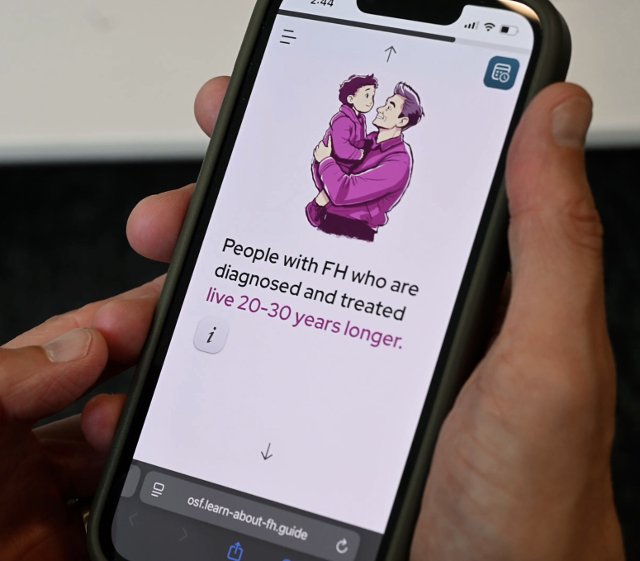
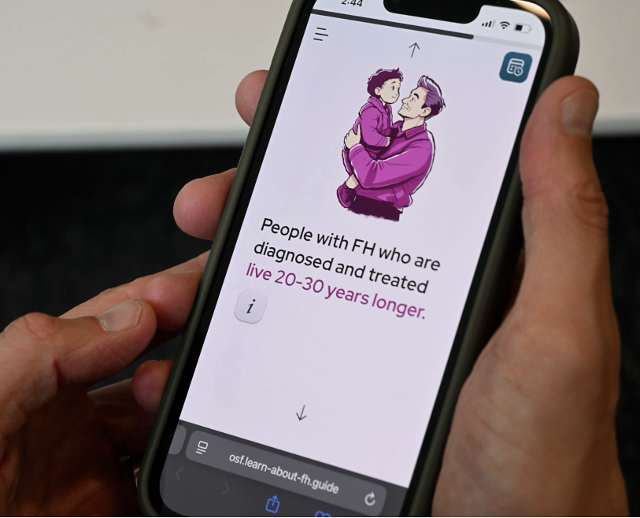
Understanding FH—and the importance of early detection—isn’t easy in a world flooded with information. That’s why the pilot program teamed with OSF Innovation’s Medical Visualizationteam, to create for people identified at possible risk, mobile-friendly education designed to meet people where they are.
Loudermilk emphasizes it’s not just a brochure. The visuals use a unique, semi-animated shimmer effect that adds emotional weight without overwhelming the viewer.
“It’s something that can be easily read on their cell phone; they don’t have to log onto a computer. It’s something that’s eye-catching, something that’s straight to the point – what your risks are, why it’s important for you to get tested and checked … thinking about family members, so it speaks to that. It speaks to the ease of this. That’s the other big piece of this.”
A Simple Test with a Big Impact
The testing process is easy. It’s just a cheek swab with no needles or blood draw. It takes a couple minutes.
The pilot is tracking how many people go on to be screened after the initial outreach with a goal of at least 30%. The initiative will follow not just how many patients test positive, but how many then go on to get family members tested, the true measure of ripple effect success. Additionally, the pilot includes having the Medical Visualization team provide insights about which content drove the most engagement.
The FH pilot is part of a broader effort at OSF HealthCare to advance care through personalized medicine that is specific to a person’s genetic make-up. Loudermilk sees a time in the future where genetic testing will be even easier.
“Where I could see this going – a patient doesn’t even have to come in. These kits could actually be mailed to them, to their house and they could do the check swab themself and get it mailed in. So, those who don’t want to deal with making an appointment and seeing their provider in person, they could do a virtual visit and have the kit sent to them. That’s the future of all of this.”
If you receive primary care in Bloomington, talk to your provider if you think you would like to be screened for familial hypercholesterolemia.
More like this:
- Most Popular


- Top Stories


- Most Recent


- Sign In
- Home
- Video
- News
-
Weather
 Sponsored by Michael Ryan Exteriors - Roofing Professionals
 - Sports
- Obits
- Events
- Radio
- AP News
- Shop Local
- Classifieds
- Autos
- Real Estate
- Directory
Follow Us
Copyright © 2026 RiverBender.com All rights reserved.
primary