


75 Years Ago: Early Breast Cancer Detection Film Saves Lives
How did a 1950 film empower women to detect breast cancer early in Alton and beyond? Find out now.

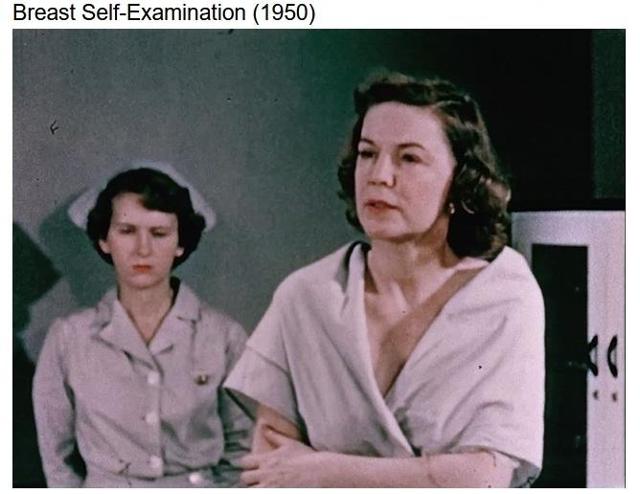
An American Cancer Society film, titled “Breast Self-Examination,” premiered locally on December 2, 1950, at the Stratford Hotel’s Alton Room. The Madison County Chapter of the American Cancer Society hosted the showing and invited leaders of Alton area women’s organizations. The film taught women how to examine their own breasts for cancer in a simple, four-step method modeled after that which doctors use. At the time, 50,000 American women annually developed breast cancer, and more than half of them died within five years. The main culprit was late diagnosis and treatment, and medical authorities believed that with early detection, between eighty and ninety percent of these deaths could be prevented. The American Cancer Society and the National Cancer Institute of the U.S. Public Health Service co-produced the film
Get The Latest News!
Don't miss our top stories and need-to-know news everyday in your inbox.
Miss Audrey Campbell, Director of Public Education of the Illinois division of the American Cancer Society, came to Alton for the showing. Verna Huber (listed as Mrs. Emil Huber), chairperson of the Madison County chapter of the Society, organized the event. Clara Foster (listed as Mrs. H. Clark Foster), chairperson of the lay speakers’ bureau for the Madison County chapter, introduced Dr. Bernard A. Donnelly. Dr. Donnelly gave a talk prior to the film and participated in a question-and-answer session afterwards.
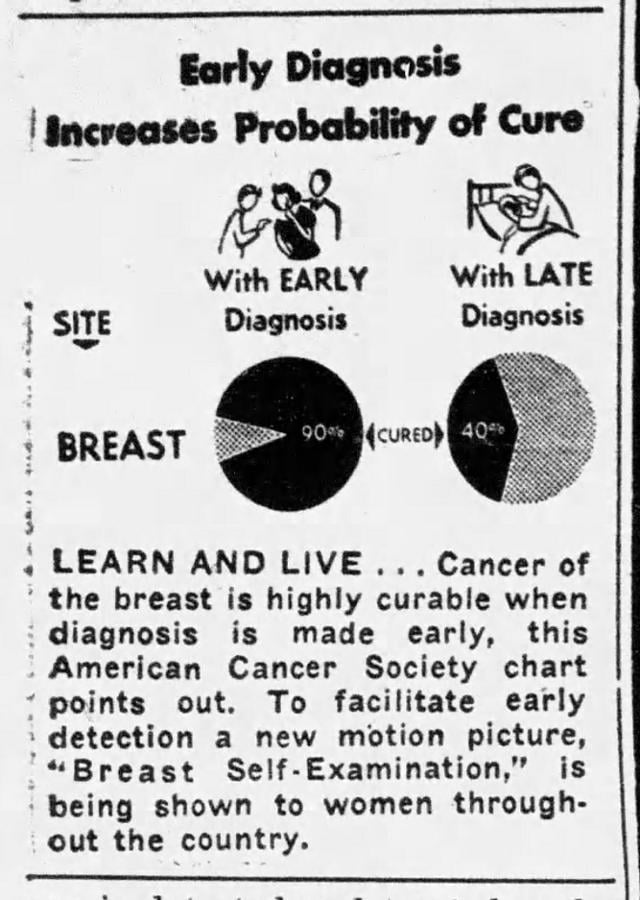
The film was shown several times again in Alton over the next few months. On January 22, 1951, the American Legion Auxiliary hosted a screening at the American Legion Hall on George Street. Dr. Maybelle P. Williams addressed the group. The Alton Nurses’ Club viewed the film on February 1, 1951, and the Alton YWCA showed the film at their “Ladies Day Out” Luncheon on February 15, 1951. Sixty-eight women watched it at St. Matthew’s Church hall following an Altar Society meeting on April 4, 1951.
To encourage groups to host their own showings and reach an even wider audience, announcements in the Alton Telegraph about these film showings concluded with the following: The film is available for distribution to all adult women’s organizations, and can be reserved by writing to Information Center, Madison County Chapter, American Cancer Society, 203-A East Broadway, Alton, the phone number is 2-6821.
“Breast Self-Examination” (certainly a product of its time: all women are white and both doctors are male) can be seen on the National Film Preservation Foundation website. It was scanned from a 16mm print held by the Library of Congress.:https://www.filmpreservation.org/preserved-films/screening-room/breast-self-examination-1950
Lacy’s note: Why “75 Years Ago” instead of my usual “100 Years Ago”? In October 2024, I was diagnosed with breast cancer. It was a shock. I went in for my routine mammogram about a month after turning forty, and there were anomalies. After sonograms, MRIs, and several biopsies, I got the official diagnosis: ductal carcinoma in situ, which is considered Stage 0. It’s cancer, but it’s pre-invasive. I underwent surgery and radiation and am now cancer-free. (I’ll take Tamoxifen for five years to lower my risk of getting breast cancer again.) One of the things I did as I was dealing with my feelings about my cancer was look up historical information about breast cancer. I feel so grateful to be living in a time when advanced screening means that there’s an incredibly high survival rate now. The survival rate for Stage 0 cancer after five years is basically 100%, and the five-year survival rate after an invasive breast cancer diagnosis is 91%. According to the American Cancer Society’s website, survival rates are over 99% for localized cancer, 87% for regional, and 32% for distant. The majority of breast cancer diagnoses, 66%, are localized, and when all stages are combined, the average is 91%. In 1950, the five-year survival rate was less than 50%. It wasn’t until the late 1960s that mammography started to be used consistently as a screening tool. With advanced imaging, medical professionals found my cancer before it could even get big enough to form tumors that could be felt during a self-exam or doctor’s exam. Please get a mammogram: getting a cancer diagnosis isn’t ever fun, but knowing from the beginning that you won’t die from it (as long as you treat it) definitely makes it easier.
Sources
“Breast Cancer Film to Be Shown.” Alton Evening Telegraph (Alton, IL), January 22, 1951.
“Breast Cancer Film to Be Shown Women’s Leaders.” Alton Evening Telegraph (Alton, IL), November 28, 1950.
“Dr. Maybelle Williams.” Alton Telegraph (Alton, IL), December 17, 1994.
“Dr. Maybelle Williams Named Resident Physician at St. Joseph’s Hospital.” Alton Evening Telegraph (Alton, IL), August 17, 1938.
Nicosia, Luca, Giulia Gnocchi, Ilaria Gorini, Massimo Venturini, Federico Fontana, Filippo Pesapane, Ida Abiuso, Anna Carla Bozzini, Maria Pizzamiglio, Antuono Latronico, and et al. 2023. "History of Mammography: Analysis of Breast Imaging Diagnostic Achievements over the Last Century" Healthcare 11, no. 11: 1596.https://doi.org/10.3390/healthcare11111596
“Survival Rates for Breast Cancer.” American Cancer Society, Inc., 2025.https://www.cancer.org/cancer/types/breast-cancer/understanding-a-breast-cancer-diagnosis/breast-cancer-survival-rates.html
“Understanding Breast Cancer Survival Rates.” Breast Cancer Research Foundation, 2025.https://www.bcrf.org/about-breast-cancer/breast-cancer-survival-rates/
“Women View Film.” Alton Evening Telegraph (Alton, IL), April 5, 1951.
“YWCA To Show Cancer Film Thurs.” Alton Evening Telegraph (Alton, IL), February 13, 1951.
More like this:
- Most Popular


- Top Stories

- Most Recent



- Sign In
- Home
- Video
- News
-
Weather
 Sponsored by Michael Ryan Exteriors - Roofing Professionals
 - Sports
- Obits
- Events
- Radio
- AP News
- Shop Local
- Classifieds
- Autos
- Real Estate
- Directory
Follow Us
Copyright © 2026 RiverBender.com All rights reserved.
primary