


Durbin Warns Of Crypto Risks Ahead Of Senate Committee Markups
Senator: "Rushing this process poses a danger to the U.S. financial system."

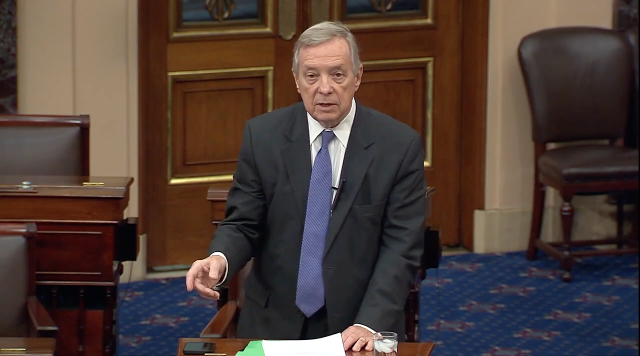
WASHINGTON – As the Senate Banking and Agriculture Committees consider cryptocurrency market structure legislation this week, U.S. Senate Democratic Whip Durbin, a member of the Senate Agriculture Committee, urged the Committee Chairmans to work across the aisle to explore proper protections and regulations in the crypto market before moving forward. In his remarks, Durbin noted that crypto assets are a risky, volatile, and unpredictable investment.
Get The Latest News!
Don't miss our top stories and need-to-know news everyday in your inbox.
Durbin said, “While we await the release of the bill text, let me be clear: a strong crypto market structure bill must include the following provisions: ensure protections for investors, especially retail consumers; protect victims from fraud and crypto ATM scams; strengthen our financial stability; provide strong guardrails against money laundering; and prevent the President and his family from further enriching themselves.”
During his speech, Durbin reflected on the 2008 financial crisis which was spurred, in large part, by risky, subprime mortgages. The Federal Deposit Insurance Corporation (FDIC) has stated that “Financial innovation and deregulation contributed to an environment in which the U.S. and global financial systems became […] far less stable than in previous decades.”
Durbin continued, “In the wake of this [the 2008 financial crisis], Congress moved to prevent a future crisis. We passed the Dodd-Frank [Act], providing much needed reforms to the financial system that protected consumers and increased accountability of Wall Street. But it has been nearly 16 years since Dodd-Frank was signed into law, and the financial system in America has changed dramatically. Today, it is the rise of cryptocurrency—a risky, volatile, and unpredictable investment—that requires meaningful regulation.”
The crypto industry has wide reach, with its value exceeding $4 trillion in 2025. Estimates show that the industry has 40 to 70 million active users each month.
“Naturally, the crypto industry is calling for rubber stamp regulation of this asset in the name of ‘innovation.’ Sound familiar? It’s the same reasoning the FDIC gave as the cause for the Great Recession. What does this mean? The next crypto crash could wipe out not just the fat cats, but a lot of working families—just like in 2008,” said Durbin.

Durbin then criticized the Trump Administration for failing to put in place common sense guardrails that would fend off another market collapse. Since returning to office, financial regulators like the U.S. Securities and Exchange Commission (SEC) have dropped lawsuits against some of the largest, most dubious crypto companies, creating an environment of unaccountability.
“President Trump has pushed for deregulation of financial markets, including by taking his chainsaw to the Consumer Financial Protection Bureau in the name of ‘government efficiency.’ He has pardoned crypto executives that have allowed funds to flow to terrorists, drug cartels, and cybercriminals. And Trump has personally enriched himself, to the tune of nearly one billion dollars in just the first half of 2025, through crypto scams like memecoins,” said Durbin.
Durbin then spoke about crypto ATMs. Durbin previously introduced theCrypto ATM Fraud Prevention Act to help prevent scammers from stealing Americans’ savings through cryptocurrency schemes. Durbin’s legislation aims to crack down on crypto scams by adding layers of protections to crypto ATM transactions and requiring greater transparency from cryptocurrency ATM operators.
“These scams swindle unsuspecting Americans, usually senior citizens, who receive a phone call telling them that they owe taxes to the IRS or a penalty for missing jury duty. The scammer tells the victim that they can pay what they owe at a crypto ATM. Little does the victim know that the money they deposit into the crypto ATM [machine] is transferred to the criminal’s digital wallet… The FBI estimates that in 2025, victims lost more than $333 million to scams facilitated by crypto ATMs,” Durbin continued.
Durbin concluded by calling on Congress to meaningfully regulate the crypto industry and address the scams—noting Congress cannot make the same mistakes that leads up to the 2008 financial crisis.
Durbin said, “And we cannot expect taxpayers to support a multi-billion-dollar bailout for the crypto industry if there’s a crypto crash. Capitulating to the crypto industry and the self-imposed rush to mark up these forthcoming crypto market structure bills comes at the direction of a President who is trying to enrich himself.”
Durbin concluded, “As the Senate Banking and Agriculture Committees consider cryptocurrency [legislation], I advise Chairmans Scott and Boozman to work across the aisle to explore proper protections and regulations in the crypto market. Rushing this process is unwise and poses a serious danger to the U.S. financial system.”
More like this:


- Most Popular


- Top Stories



- Most Recent



- Sign In
- Home
- Video
- News
-
Weather
 Sponsored by Michael Ryan Exteriors - Roofing Professionals
 - Sports
- Obits
- Events
- Radio
- AP News
- Shop Local
- Classifieds
- Autos
- Real Estate
- Directory
Follow Us
Copyright © 2026 RiverBender.com All rights reserved.
primary