


Durbin Presses Trump’s Judicial Nominee About His Involvement In A Controversial Pro-Gun Group
Durbin questioned judicial nominees during a Senate Judiciary Committee hearing
Get The Latest News!
Don't miss our top stories and need-to-know news everyday in your inbox.
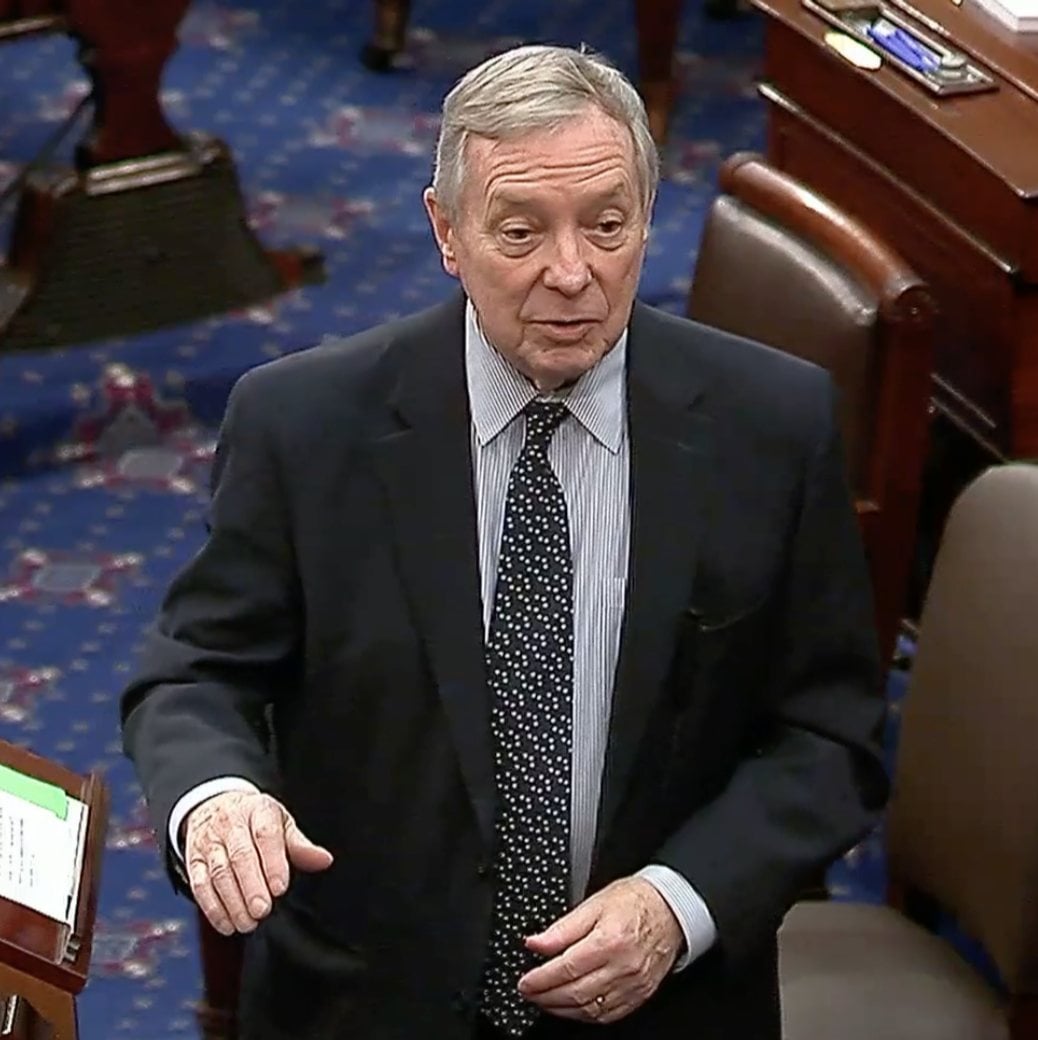
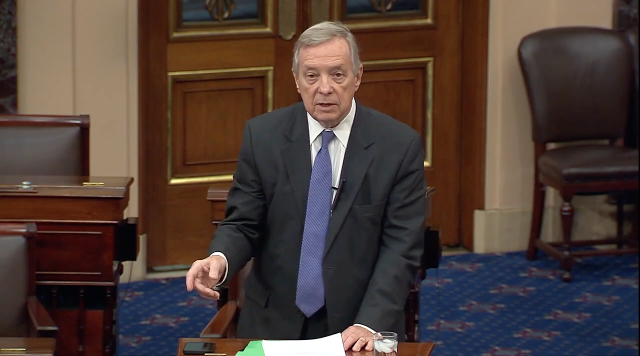
WASHINGTON – U.S. Senate Democratic Whip Dick Durbin (D-IL), Ranking Member of the Senate Judiciary Committee, today questioned judicial nominees during a Senate Judiciary Committee hearing. Durbin first questioned Arthur Roberts Jones, nominated to the U.S. District Court for the Southern District of Texas, about his recent involvement with Gun Owners of America. The organization has criticized the National Rifle Association (NRA) for being too moderate, proudly claiming that it is “the only no-compromise gun lobby,” and has taken extreme positions on firearm safety. Gun Owners of America has called for the Bureau of Alcohol, Tobacco, Firearms, and Explosives (ATF) to be abolished, and its former executive director claimed that “all gun laws are unconstitutional.”
“Why did you join Gun Owners of America?” Durbin asked.
Mr. Jones responded that he only joined the organization at a “low-level” membership. He continued to say he would resign if confirmed.
“Do you share the Gun Owners of America view that the Second Amendment renders all gun laws unconstitutional?” Durbin asked.
Mr. Jones refused to respond to Durbin’s question—and instead referred to it as a “political” question.
“You voluntarily joined this organization with radical views and now that is part of your biography before this Committee. If you want to make it clear that you now have changed your views or explain why you joined the organization, here is your chance. But to duck it and say, ‘I don't have to comment on this’ is to leave us with a conclusion you agree with them,” Durbin said.
Mr. Jones responded that he does not believe the organization is categorized as radical and continued to dodge Durbin’s question.
“So, you say that their position that all gun laws are unconstitutional is not radical?” Durbin asked.
Mr. Jones again dodged Durbin’s question.
Durbin then asked Michael J. Hendershot, nominated to the U.S. District Court for the Northern District of Ohio, about voting rights litigation.
“If you are confirmed to the district court and issue a decision, would the parties before you be required to comply with your decision and any orders you or the district court may issue?” Durbin asked.
Mr. Hendershot responded, “That would be my expectation, short of things such as a stay or an appeal.”
Durbin followed up, “But once that process is exhausted, appeals or whatever, do you expect the parties to follow the orders of the court?”
Mr. Hendershot responded, “I would expect that.”
“I ask because, between 2021 and 2023, you defended Ohio’s state legislative and congressional maps. The Ohio Supreme Court ruled five times that the state legislative maps violated the state constitution. It also struck down the state’s congressional maps twice. If you are confirmed to the district court, will you condone or permit the kind of repeated resistance to court orders that the Ohio Redistricting Commission engaged in?” Durbin asked.
Mr. Hendershot gave a jumbled response to Durbin’s question and claimed that to “engage with a hypothetical… would be inside the space of the canons’ fence-off.”
“So, you believe it is arguable as to whether or not a party is bound by a court order?” Durbin asked.
Mr. Hendershot replied, “My understanding of the canons… is to not prejudge a case other than talking about issues at a high level of generality. Otherwise, [you] could prejudge a case that may be pending.”
Durbin responded, “This is the opposite. You were not prejudging. You were representing a client who was resisting a court order. The Supreme Court of [Ohio] ruled five times that the maps violated the state constitution… It would seem to me that as a judge you would expect a lawful order to be followed. Is that correct?”
Mr. Hendershot said, “I do expect lawful orders to be followed,” but then continued to claim the question was a hypothetical.
More like this:



- Most Popular


- Top Stories



- Most Recent


- Sign In
- Home
- Video
- News
-
Weather
 Sponsored by Michael Ryan Exteriors - Roofing Professionals
 - Sports
- Obits
- Events
- Radio
- AP News
- Shop Local
- Classifieds
- Autos
- Real Estate
- Directory
Follow Us
Copyright © 2026 RiverBender.com All rights reserved.
primary