


Durbin Statement On Supreme Court Weakening Landmark Criminal Justice Reform Law
As an author of the First Step Act, Durbin passed landmark bipartisan criminal justice reform legislation into law in 2018 with the intent to expand compassionate release

Get The Latest News!
Don't miss our top stories and need-to-know news everyday in your inbox.
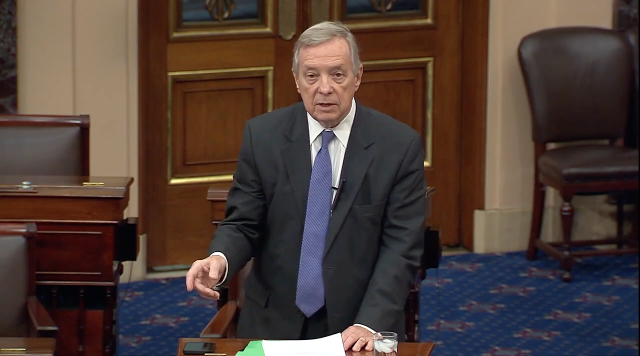
SPRINGFIELD – U.S. Senate Democratic Whip Dick Durbin (D-IL), Ranking Member of the Senate Judiciary Committee, released the following statement after the Supreme Court limited federal judges’ discretion under the compassionate release provisions of the First Step Act in rulings in Fernandez v. United States and Rutherford v. United States today:
“The Supreme Court just significantly weakened a landmark, bipartisan criminal justice reform law in defiance of Congressional intent.
“When we wrote the First Step Act, we clearly sought to expand federal judges’ discretion to consider compassionate release as part of an effective smart-on-crime approach to reforming our justice system.
“We will be exploring options to uphold the integrity of the First Step Act, including further legislation.”
Durbin and U.S. Senator Cory Booker (D-NJ) had urged the Justices to reverse the Second Circuit’s judgment in Fernandez and urged the Court to reverse the Third Circuit’s judgment in Rutherford.
Championed by Durbin, Booker, and U.S. Senators Chuck Grassley (R-IA) and Mike Lee (R-UT), the First Step Act was signed into law in 2018 andserves as a beacon for “smart on crime” policies. The law makes the Fair Sentencing Act’s reforms retroactive, and:
- Requires the Department of Justice to develop a risk and needs assessment system to evaluate the recidivism risk of all prisoners, place them in programs and activities to reduce risk, and permit early transition into prerelease custody based on earned time credits;
- Reduces mandatory minimum sentences for some drug trafficking offenses;
- Expands the safety valve to allow judges to sentence low-level, nonviolent drug offenders with minor criminal histories to less than the required mandatory minimums; and
- Authorizes incarcerated individuals to file compassionate release motions in federal court.
These reforms have been tremendously successful. As noted in a January 2024 hearing, of the 44,671 incarcerated adults then-released under First Step Act reforms, only 9.7 percent had been arrested for new crimes. By comparison, the overall Bureau of Prisons recidivism rate currently stands at around 45 percent. To date, there have been 4,165 retroactive sentence reductions and 4,973 compassionate release motions granted.
More like this:


- Most Popular



- Top Stories



- Most Recent


- Sign In
- Home
- Video
- News
-
Weather
 Sponsored by Michael Ryan Exteriors - Roofing Professionals
 - Sports
- Obits
- Events
- Radio
- AP News
- Shop Local
- Classifieds
- Autos
- Real Estate
- Directory
Get the RiverBender App


Follow Us
Copyright © 2026 RiverBender.com All rights reserved.
primary