


June 17 in History: Bunker Hill, Watergate and Other Events That Shaped the World
A look back at June 17 includes the Battle of Bunker Hill, the arrival of the Statue of Liberty, the East German uprising and the Watergate break-in.
On June 17, the most far-reaching event in world history is the Battle of Bunker Hill in 1775, one of the earliest major clashes of the American Revolutionary War. Fought near Boston, the battle showed that colonial forces could stand up to the British Army in open combat, even though the British eventually took the ground. At the time, it changed how both sides viewed the conflict: Britain saw that defeating the rebellion would be harder and costlier than expected, while the colonists gained confidence that their resistance could become a full-scale war for independence. It still matters today because it marked a turning point in a struggle that helped reshape ideas about self-government, empire, and political change far beyond North America.
The road to Bunker Hill began after rising tensions between Britain and its American colonies over taxes, representation, and imperial control. In April 1775, fighting at Lexington and Concord had already turned a political dispute into armed conflict. By June, colonial militia forces had fortified positions overlooking Boston, where British troops were stationed. On June 17, British soldiers attacked the colonial defenses on Breed’s Hill, in the battle commonly known as Bunker Hill. The British won the field after repeated assaults, but at heavy cost. Their losses were so severe that the battle became a warning about the price of trying to suppress the rebellion by force. For the colonists, the battle became a symbol of determination and military potential, even in defeat.
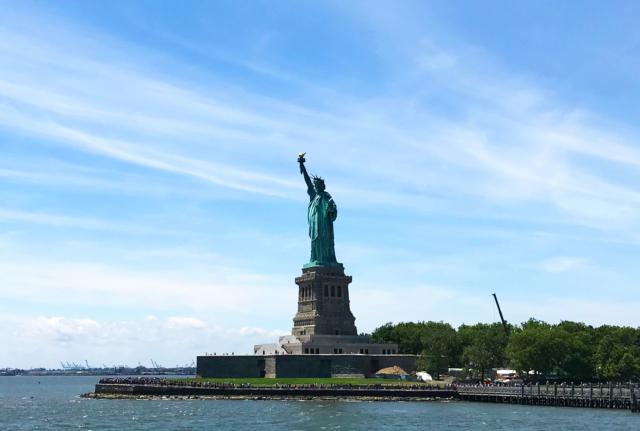
In 1885, the Statue of Liberty arrived in New York Harbor from France. While not a battle or treaty, its arrival carried real political meaning. The monument honored the friendship between France and the United States and reflected shared ideals tied to liberty and republican government. Over time, it also became one of the most recognized symbols of immigration and national identity. For millions arriving by sea in the late nineteenth and early twentieth centuries, the statue became linked with hopes for safety, work, and a new beginning.
During the Cold War, June 17 took on another meaning in 1953 with the East German uprising. What began as labor protests in East Berlin over work demands quickly spread into a broader challenge to the communist government. Demonstrators called for economic relief, political change, and greater freedom. Soviet troops and tanks were used to suppress the protests, and many people were arrested or killed. Although the uprising failed in the short term, it revealed deep public dissatisfaction inside the Eastern Bloc. In later decades, it was remembered as an early sign that Soviet-backed systems in Eastern Europe rested on unstable ground.
June 17 has also left its mark on American politics through the 1972 break-in at the Democratic National Committee headquarters in the Watergate complex in Washington, D.C. At first, the break-in appeared to be a limited act of political espionage. As investigations unfolded, however, it became clear that the incident was tied to a wider abuse of power connected to President Richard Nixon’s re-election campaign and efforts to cover up wrongdoing. Watergate eventually led to Nixon’s resignation in 1974. Its long-term importance lies in how it changed public trust in government, strengthened investigative journalism’s reputation, and became a lasting example of the role of checks and balances in a constitutional system.
Not every important event on this date came from war or politics. In 1994, the opening match of the FIFA World Cup was held in the United States, beginning a tournament that helped broaden soccer’s visibility in a country where it had long stood behind other major sports. The event mattered internationally as well, drawing large crowds and reinforcing the World Cup’s role as one of the world’s major cultural gatherings. Sports often work as a shared global language, and this tournament showed how major events can help new audiences connect to an already global game.
Among notable births on June 17, one of the best known is Igor Stravinsky, born in 1882 in Russia. He became one of the most influential composers of the twentieth century. Works such as The Firebird, Petrushka, and The Rite of Spring changed modern music with bold rhythms, new forms, and unexpected sounds. His career crossed several countries and musical styles, reflecting the movement and experimentation of his era.
Another significant figure born on this date was Charles Eames in 1907, an American designer, architect, and filmmaker. Working closely with Ray Eames, he helped shape modern design in ways that reached far beyond furniture. Their work combined practicality, beauty, and new industrial methods, influencing architecture, education, and everyday objects. Much of what is now thought of as modern design owes something to their approach.
In 1943, Barry Manilow was born in the United States. As a singer, songwriter, and performer, he became a major figure in popular music with a long career spanning decades. His success in adult contemporary and pop music made him part of the wider story of mass media and modern entertainment, where radio, television, touring, and recording all worked together to build global celebrity.
A different kind of public influence is represented by Kendrick Lamar, born in 1987. The American rapper and songwriter is widely recognized for lyric-driven music that explores identity, place, memory, and social life. His work reflects how hip-hop developed from a local cultural movement into one of the world’s most important musical forms.
This date is also associated with notable deaths. In 1631, Mumtaz Mahal died in India. She is remembered above all because her death led the Mughal emperor Shah Jahan to commission the Taj Mahal, one of the world’s most famous buildings. Though she was not a political figure in the modern sense, her memory became tied to a monument that still represents artistic achievement, imperial history, and personal grief transformed into architecture.
In 1996, Thomas Kuhn died in the United States. He was a historian and philosopher of science whose book The Structure of Scientific Revolutions changed how many people understood scientific progress. Kuhn argued that science does not always move forward in a simple, steady line, but often through major shifts in accepted ideas. His work influenced not only philosophy and history but also wider discussions about knowledge and change.
Taken together, the events of June 17 show how history is shaped by battles, protest movements, scientific breakthroughs, works of art, and individual lives.
More like this:




- Most Popular



- Top Stories



- Most Recent



- Sign In
- Home
- Video
- News
-
Weather
 Sponsored by Michael Ryan Exteriors - Roofing Professionals
 - Sports
- Obits
- Events
- Radio
- AP News
- Shop Local
- Classifieds
- Autos
- Real Estate
- Directory
Get the RiverBender App


Follow Us
Copyright © 2026 RiverBender.com All rights reserved.
primary