Nov. 6 in Sports History: College Football’s First Game and Other Milestones
The date marks Rutgers and Princeton’s 1869 meeting, recognized as the first intercollegiate football game, along with milestones in ultimate, soccer, the NFL and marathon racing.

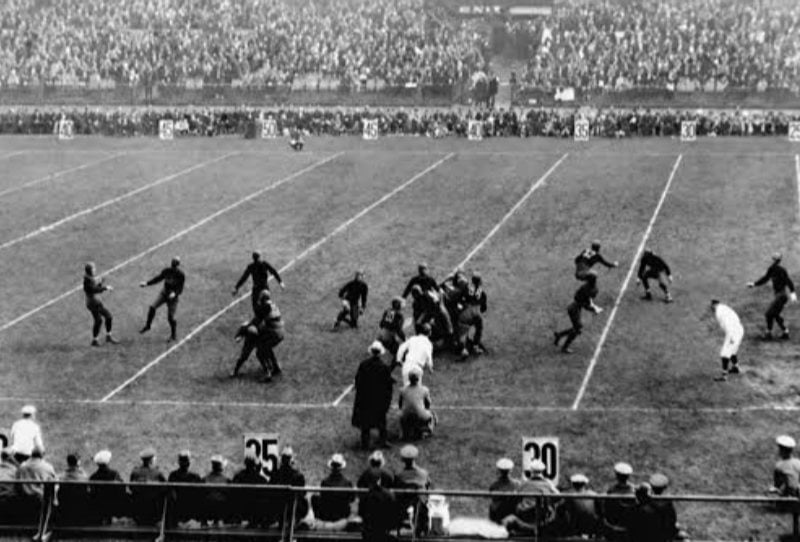 College football’s history began with a game that would look unfamiliar to fans today. On Nov. 6, 1869, Rutgers defeated Princeton 6-4 in New Brunswick, New Jersey, in the contest recognized as the first intercollegiate football game. The lasting importance was not the score, but the meeting itself: Two colleges had agreed to compete in a sport that would develop into a major part of American athletics.
As Nov. 6, 2026, marks the game’s 157th anniversary, the date also recalls another college sport’s beginning, a transformative soccer appointment, an NFL relocation announcement and a marathon decided in its final strides. These milestones show how sports history can turn on an agreement, an administrative decision or a finish too close for rounded times to fully explain.
Get The Latest News!
Don't miss our top stories and need-to-know news everyday in your inbox.
Rutgers and Princeton each fielded 25 players in that 1869 meeting. Rutgers captain William J. Leggett proposed rules drawn from the London Football Association, and Princeton accepted. About 100 spectators gathered for the afternoon contest. Rather than touchdowns and extra points, the teams competed for goals, making the 6-4 result fundamentally different from the same score in modern football.
The game was tied 4-4 before Rutgers scored the final two goals. According to Rutgers’ historical account, Leggett instructed his players to keep the ball low to counter Princeton’s advantage in height. Strategy helped decide the opening chapter of a sport whose rules and style would change substantially in the decades that followed.
Exactly 103 years later, on Nov. 6, 1972, the same schools supplied another starting point. Rutgers defeated Princeton 29-27 in the first intercollegiate ultimate game. The organizers deliberately connected their new competition to the football milestone, staging it on the same ground, which by then had become a commuter parking lot. Once again, Rutgers won by two.
Rutgers organizers Geoff West and Irv Kalb marked off the playing area with white tape. Both had graduated from Columbia High School in Maplewood, New Jersey, where ultimate originated. The college debut attracted about 1,100 spectators and coverage beyond the campus newspaper. It brought a young sport to a broader audience and helped establish a college tradition that extended well beyond the original participants.
The significance was larger than one successful publicity effort. Rutgers went on to win 29 of its first 30 games, and college ultimate continued to develop. A national collegiate championship followed at Yale in 1975. The parking-lot matchup was an early step toward organized competition on a much wider scale.
On Nov. 6, 1986, Manchester United appointed Alex Ferguson as manager, beginning a tenure that reshaped the English soccer club. Ferguson arrived from Aberdeen, taking over a job whose eventual rewards were still years away. His appointment’s 40th anniversary falls on this date in 2026.
The breakthrough came with the 1990 FA Cup, Ferguson’s first trophy at United. His teams later won 13 Premier League titles and two Champions League titles, part of a total of 38 trophies before he retired in 2013. The November appointment therefore began not a brief turnaround, but a period of success lasting more than a quarter-century.
The defining achievement came in 1999, when United won the Premier League, FA Cup and Champions League in the same season. That treble demonstrated the reach of the program Ferguson had built: His team could prevail across a league schedule and in domestic and European cup competition.
On Nov. 6, 1995, Cleveland Browns owner Art Modell announced at Camden Yards in Baltimore that he had signed an agreement to relocate his team for the 1996 season. The announcement set in motion a change affecting two cities and raised a consequential question: What parts of a team’s identity could remain behind when its owner and personnel left?
The eventual settlement kept the Browns’ name, colors, history, records and archives in Cleveland. Modell’s organization began playing in Baltimore as the Ravens in 1996, while the Browns were deactivated for three seasons. Football returned to Cleveland in 1999. The distinction mattered: Cleveland lost its team on the field temporarily, but did not lose ownership of its football past.
On Nov. 6, 2005, Kenya’s Paul Tergat won the New York City Marathon after a prolonged duel with defending champion Hendrick Ramaala of South Africa. Their attacks and counterattacks continued into the closing stretch, with Tergat reaching the finish barely ahead. His official time was 2 hours, 9 minutes, 30 seconds; Ramaala was credited with 2:09:31.
The rounded results understated the closeness. New York Road Runners’ historical account puts the actual separation at roughly three-tenths of a second. Latvia’s Jelena Prokopcuka added another landmark that day, winning the women’s race in 2:24:41 to become the event’s first Latvian champion. A date remembered for beginnings and sweeping organizational changes also produced a reminder that, after 26.2 miles, a championship can depend on the final step.
More like this:
- Most Popular



- Top Stories


- Most Recent