

This Day in Sports History: Nov. 16, From Oklahoma’s Streak to Messi’s Debut
On Nov. 15: Elgin Baylor’s 71-point game anchors a Nov. 15 timeline spanning MVP honors, a NASCAR title decided by one lap and Holly Holm’s upset of Ronda Rousey.
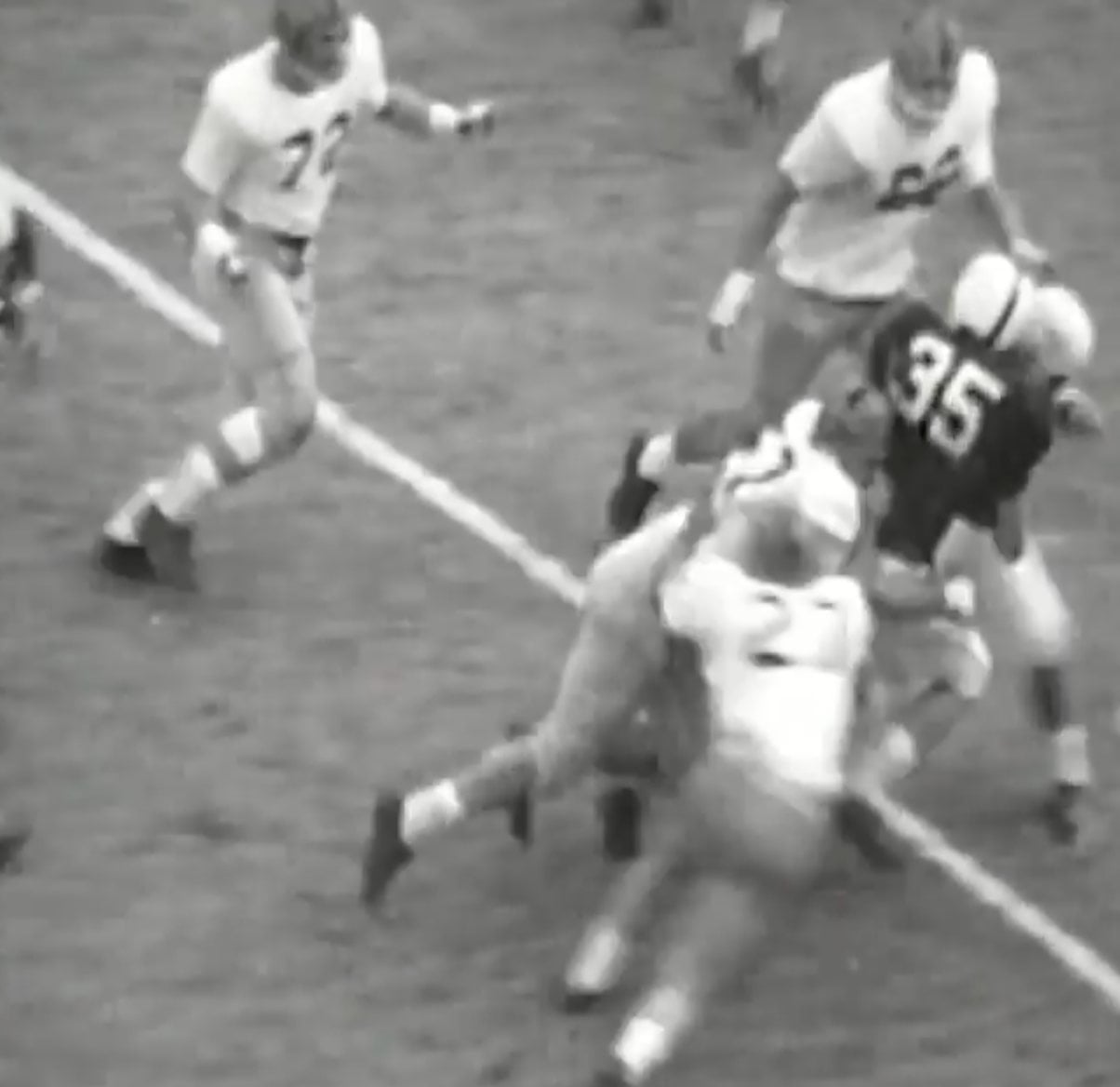
Oklahoma’s extraordinary winning streak ended not with a shootout, but with a single touchdown. On Nov. 16, 1957, Notre Dame defeated the Sooners 7-0 in Norman, Oklahoma, stopping a run of 47 consecutive victories and delivering one of college football’s defining upsets. The result brought a sudden halt to a stretch of dominance that had made Oklahoma the defending national champion and an imposing opponent even on an ordinary Saturday.
For this Nov. 16, 2026, look back, that breakthrough begins a chronological journey through record-setting football, a future soccer star’s first appearance, a nation’s long-awaited World Cup return and an unusual tennis championship. Each moment illustrates a different way a date becomes part of sports history: through an upset, an individual performance, an introduction, a release of national frustration or a trophy awarded without a final being played.
Get The Latest News!
Don't miss our top stories and need-to-know news everyday in your inbox.
Notre Dame arrived unranked to face second-ranked Oklahoma in 1957. The teams remained scoreless until the fourth quarter, when the Fighting Irish assembled a 20-play, 80-yard drive. Facing fourth-and-goal from the 3-yard line, quarterback Bob Williams pitched to Dick Lynch, who scored the game’s only touchdown. Williams later intercepted an Oklahoma pass in the end zone with less than a minute remaining, protecting the lead and completing the upset.
The victory ended more than the winning streak. Oklahoma also was shut out for the first time in 123 games. Notre Dame had been the last team to defeat the Sooners, in their 1953 season opener, giving the Irish an unusual place at both ends of Oklahoma’s run. The 1957 game paired a sustained offensive drive with a decisive defensive stop, a fitting combination for a result remembered as much for what Oklahoma could not do as for what Notre Dame accomplished.
Eleven years later, on Nov. 16, 1968, Michigan running back Ron Johnson turned a cold, rainy afternoon in Ann Arbor into a record-setting performance. Johnson rushed for 347 yards on 31 carries and scored five touchdowns as the Wolverines defeated Wisconsin 34-9. His scoring runs covered 35, 67, 1, 60 and 49 yards, showing how repeatedly he broke through for gains that changed the game.
Johnson did his greatest damage after halftime, rushing for 249 yards and four touchdowns while Wisconsin went scoreless in the second half. His rushing total established a Big Ten record, and his five touchdowns matched the conference mark set by Illinois great Red Grange against Michigan in 1924. Johnson’s afternoon thus connected two memorable performances in Big Ten history, with the Wolverines on opposite sides of the achievement. He finished the season as the Chicago Tribune Silver Football winner, recognized as the conference’s most valuable player.
On Nov. 16, 2003, Lionel Messi made his first appearance for Barcelona’s senior team, entering a friendly against Porto at age 16. Coach Frank Rijkaard sent him on for Fernando Navarro in the 71st minute of a match marking the opening of Porto’s Estadio do Dragao. Barcelona lost 2-0, and Messi wore No. 14 rather than the No. 10 that later became closely associated with him.
The distinction between a friendly appearance and an official competitive debut matters: This was an introduction to the first team, not the start of his official Barcelona statistical record. In retrospect, however, the significance is clear. Messi went on to score 672 goals in 778 official appearances for Barcelona and win 35 trophies with the club, including 10 Spanish league titles and four Champions League titles. A teenage substitute’s brief appearance became an early marker in a career that transformed the club’s record book.
On Nov. 16, 2005, Australia ended a 32-year absence from the men’s World Cup by overcoming Uruguay in Sydney. Trailing after the first leg of their qualifying playoff, the Socceroos won the return match 1-0 on Mark Bresciano’s goal, leaving the teams tied 1-1 on aggregate. Extra time produced no separation, sending a World Cup berth to a penalty shootout.
Goalkeeper Mark Schwarzer saved two Uruguay penalties, and John Aloisi converted the decisive kick as Australia won the shootout 4-2. For coach Guus Hiddink’s team, the immediate reward was a place at the 2006 tournament in Germany. For Australian supporters, the result ended decades of waiting. Aloisi’s celebration and Schwarzer’s saves became enduring images of a night when qualification itself carried the emotional weight of a championship.
Finally, on Nov. 16, 2014, Novak Djokovic secured a third consecutive ATP World Tour Finals title in London without playing the championship match. Roger Federer withdrew before the final because of a back injury, giving Djokovic the title by walkover. It was a championship awarded after a withdrawal, not an on-court victory over Federer — an important distinction in recalling the result.
The unusual finish did not erase the historical significance of Djokovic’s achievement. He became the first player to win three straight season-ending titles since Ivan Lendl accomplished the feat from 1985 through 1987. A day that had once ended a remarkable football streak now also marked the extension of a notable tennis streak, though in circumstances neither finalist had sought.
Baylor takes NBA scoring mark to new level on this date
On Nov. 15, 1960, Elgin Baylor took NBA scoring somewhere it had never been. The Los Angeles Lakers forward scored 71 points against the New York Knicks, becoming the first player in league history to reach 70 in a game. His performance established a single-game scoring record and gave the young league a new measure of what an individual scorer could accomplish.
Looking back on Nov. 15, 2026, Baylor’s breakthrough begins a timeline that also includes recognition for two American League sluggers, an Illinois baseball resurgence, a NASCAR championship decided by precise arithmetic and a dramatic change atop women’s mixed martial arts. Each moment went beyond an ordinary victory, whether by establishing a new standard, rewarding a remarkable season or bringing a championship era to an end.
Baylor’s record came in a 123-108 Lakers victory in New York. He made 28 of 48 shots from the field and 15 of 19 free throws, while also collecting 25 rebounds. Those numbers show how complete his evening was: He supplied the scoring that separated the teams without abandoning the work around the basket. His 71 points accounted for more than half of Los Angeles’ total.
The timing mattered for the franchise, too. The Lakers had moved from Minneapolis to Los Angeles for the 1960-61 season, and Baylor’s performance delivered a historic achievement in their first season on the West Coast. The record belonged to a forward whose scoring and rebounding could shape the same game, helping establish the identity of the relocated team.
One year later, on Nov. 15, 1961, Roger Maris received the American League Most Valuable Player Award for the second consecutive season. The Yankees outfielder edged teammate Mickey Mantle 202-198 in the voting, a close finish after a season defined by their pursuit of Babe Ruth’s home run record. Maris finished with 61 home runs, surpassing Ruth’s 60 from 1927.
The award recognized more than a memorable chase. Maris drove in 141 runs during the regular season, then helped New York win the World Series against Cincinnati. His ninth-inning home run broke a tie in Game 3, putting the Yankees ahead in a game they won before taking the next two to secure the championship. The November honor capped a season in which his individual milestone and his team’s success reinforced each other.
On Nov. 15, 1972, the MVP spotlight shifted to Chicago, where White Sox first baseman Dick Allen won the American League award. Allen batted .308 and led the league with 37 home runs and 113 RBIs. He also led in walks, on-base percentage and slugging percentage, combining power with an ability to reach base that made his season stand out beyond the home run total.
Allen’s production helped make the White Sox contenders. Chicago finished 87-67, second in the AL West, during a period when the franchise’s future in the city was a concern. His first season with the club gave South Side fans both a pennant race and a player whose performance earned the league’s highest individual honor. For Illinois baseball, the award marked a meaningful season of renewed competitiveness, even without a division championship.
On Nov. 15, 1992, Atlanta Motor Speedway hosted a NASCAR finale with several histories unfolding together. Alan Kulwicki won the Winston Cup championship, Richard Petty made his final Cup start and Jeff Gordon made his first. Six drivers entered the race mathematically eligible for the title, ensuring that the farewell and debut shared attention with an unresolved championship fight.
Bill Elliott won the Hooters 500, but runner-up Kulwicki secured the championship by 10 points. The crucial detail was the lap count: Kulwicki led 103 laps to Elliott’s 102, earning the bonus for leading the most. Gordon finished 31st after crashing, while Petty’s crew repaired his damaged car enough for him to return for the final two laps. A championship calculation, a farewell and a debut made the same afternoon consequential for different generations of drivers.
On Nov. 15, 2015, in Melbourne, Australia, Holly Holm stopped Ronda Rousey to win the UFC women’s bantamweight championship. The local date was Sunday, although the event aired Saturday night in the United States. Holm finished the fight 59 seconds into the second round after landing a left kick to the head, handing Rousey her first professional mixed martial arts defeat.
Rousey entered with 12 consecutive victories and six successful UFC title defenses. Holm, a former boxing world champion, used movement and accurate counterstriking to disrupt the champion before the decisive finish. The result ended a dominant reign rather than merely changing possession of a belt. Like Baylor’s scoring breakthrough 55 years earlier, it made Nov. 15 a date when an established understanding of what could happen in competition had to change.
This Day in Sports History: Nov. 14, From Marshall’s Loss to Record-Setting Triumphs
Nov. 14 carries a meaning at Marshall University that goes far beyond a scoreboard. On this date in 1970, a chartered plane carrying football players, coaches, staff and supporters crashed near Huntington, West Virginia, killing all 75 people aboard. The loss reshaped the university and its community, making remembrance an enduring part of Marshall’s identity. On the tragedy’s 56th anniversary in 2026, that legacy stands alongside a date rich in record-setting performances and championship history.
The day’s earlier milestones include one with a lasting Illinois connection. On Nov. 14, 1943, Chicago Bears quarterback Sid Luckman threw seven touchdown passes in a 56-7 victory over the New York Giants. His performance established an NFL single-game record and gave Chicago one of the defining offensive afternoons in franchise history.
Luckman completed 21 of 32 passes for 433 yards, according to the NFL’s game log. Those numbers describe more than a comfortable victory: Seven of his 21 completions produced touchdowns, and his passing yardage alone accounted for an extraordinary afternoon of offense. The seven-touchdown performance became a benchmark against which later quarterbacks’ biggest games would be measured.
For readers in Illinois, the game is a reminder that Chicago’s football history includes an important chapter in the development of high-scoring passing attacks. Luckman’s name belongs in that story not simply because the Bears won, but because he established a single-game standard that subsequent generations of quarterbacks would chase.
On Nov. 14, 1966, Muhammad Ali retained the world heavyweight boxing championship by stopping Cleveland Williams in the third round at Houston’s Astrodome. Referee Harry Kessler ended the fight at 1 minute, 8 seconds of the round, giving Ali a technical knockout in a scheduled 15-round championship bout.
The result was Ali’s seventh defense of the heavyweight title. Rather than a long championship struggle, the contest ended before the third round was halfway complete. Its place in boxing history rests on both the successful defense and the concentrated display of the champion’s ability; Sports Illustrated revisited the performance on its 50th anniversary as one of Ali’s greatest fights.
Four years later, Nov. 14 became a day of mourning at Marshall. Southern Airways Flight 932 crashed near Tri-State Airport while bringing the football traveling party home. The 75 victims included people whose connections to the program extended from the playing field to the university and the surrounding community.
Marshall’s decision to continue football gave the aftermath another lasting chapter. A rebuilt team returned in 1971 under coach Jack Lengyel. In its first home game since the crash, on Sept. 25, quarterback Reggie Oliver connected with Terry Gardner on the final play for a 15-13 victory over Xavier. The result did not erase the loss, but it became a central moment in the program’s return.
The university’s Memorial Fountain, dedicated in 1972, provides a permanent place for remembrance. Each year on the crash anniversary, the memorial ceremony includes a wreath and the shutting off of the fountain’s water until spring. That tradition connects later generations of students and alumni with the people lost in 1970.
On Nov. 14, 1993, another milestone carried a direct connection to Chicago football history. Don Shula earned his 325th NFL coaching victory when the Miami Dolphins defeated the Philadelphia Eagles 19-14, moving past Bears founder and coach George Halas, who had finished with 324 victories. The totals included postseason games.
Miami reached the record despite having to turn to Doug Pederson after quarterback Scott Mitchell suffered a shoulder injury. Pederson entered during the third quarter and helped the Dolphins finish the victory. Shula’s record-breaking afternoon therefore reflected not only the length of his career, but also a team’s ability to win with an unexpected replacement at its most important offensive position.
On Nov. 14, 2009, Milwaukee Bucks rookie Brandon Jennings scored 55 points in a 129-125 victory over the Golden State Warriors. He broke the franchise rookie scoring record of 51 held by Kareem Abdul-Jabbar and produced the highest-scoring NBA rookie performance since Earl Monroe’s 56-point game in 1968.
The outburst came in Jennings’ seventh NBA game, making the performance remarkable for its timing as well as its total. A newcomer was already rewriting a team record associated with one of basketball’s most accomplished players. The four-point final margin also gave those points immediate value: Milwaukee needed the production to secure the victory.
On Nov. 14, 2010, Sebastian Vettel won the Abu Dhabi Grand Prix and captured his first Formula One drivers’ championship. At 23 years old, he became the youngest world champion in the sport’s history at that time. He finished the season four points ahead of Fernando Alonso after entering the finale as one of four championship contenders.
Vettel had not led the standings at any earlier point that season. His victory put him ahead when it mattered most, at the championship’s conclusion. It also began a run of four consecutive titles with Red Bull, turning a dramatic final-race breakthrough into the opening chapter of a sustained championship era.
More like this:

- Most Popular

- Top Stories


- Most Recent