


Chasing the Impossible Dream
 I was a St. Louis Cardinal scout starting in 1979 and continued for over 20 years. Each spring, the Saturday before the major league draft, I would travel to Busch Stadium and put on my Cardinal uniform number 11. If it still fit from the year before. I would conduct drills at the pre-draft camp under the direction of scouting director, Fred McAllister, as we would bring in outstanding prospects for possible signing.
In June, I would again travel to the stadium for a two-day tryout camp that was open by invitation only. There, we would conduct a tryout camp of “boys” from age 16 to 50. We would start out with over 100 candidates and over two days, we would filter them down to a couple, and offer them a contract. Bernard Gilkey, Cardinal outfielder was one we signed that made it to the major leagues. Another was Art Howe, who eventually managed the New York Mets.
Get The Latest News!
Don't miss our top stories and need-to-know news everyday in your inbox.
I say 50-year-old try-out candidates because occasionally we would get sports celebrities friends like Tom Wheatley, St. Louis Post Dispatch writer, and other television or radio personalities to try out and see if they could cut it in the drills. Most of the time they did not make it, but they had enough information or video footage for their column or show.
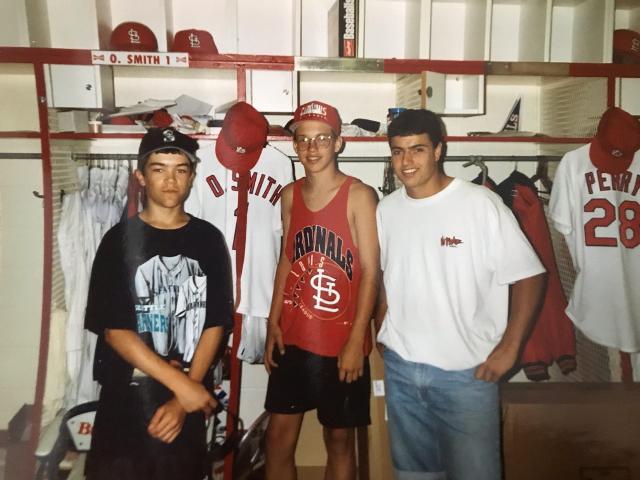
 I would take two boys each year to help conduct these tryouts. They would take care of all the Cardinal equipment and literally have the run of the stadium. Most of the boys were from Mt. Olive, but a few were from out of town. I say boys, but I took one girl in the earlier years. When I started, my son Tim was only five years old, so I took my daughter Jane as she was 10 years old. She did it until she went into high school, and she told me she has wonderful memories of that experience. When Tim got to be about 10 years old, he replaced Jane because much of the responsibility included being in the locker rooms, and she could not go into them, although she remembers being in the Cardinals locker room and seeing all of the stars’ uniforms like Ozzie and Van Slyke hanging on the lockers along with the many gifts and stacks of fan letters sent to the players. But she did the job, and I think she enjoyed it.
Tim went every year after that until he went to college, and over the years I probably took over 30 other young boys. I only requested that the boys be baseball fans and I did not care what baseball hat they were. I remember fondly, neighbor boy Billy Clayton wearing his Montreal Expos hat, as it was unique that he was a fan of them. Most of the boys wore either Cubs or Cardinals hats. Interestingly, the boys I took to handle the equipment were issued a Cardinal payroll check for their service for $15.00. Obviously, they would have done it for nothing. An interesting point to me was that not one boy took a camera with him until 1998 when Jeremy Rabida along with Ryan Pastrovich and Mike Schwab brought one. They took pictures of themselves jumping against the wall making a game saving catch, batting at the Busch Stadium home plate where heroes Mark McGwire and Ozzie Smith once stood, and standing on first base waiting to steal a base like Lou Brock. Jeff Kuenneth even slid into home plate with the “winning” run. What a lifetime experience for them!
Several years earlier Chris Elliot of Elliot Photography, a friend of mine, asked to come along and he took many pictures of the experience. He photographed a record of what we did with the kids. Often, the Cardinal players themselves would be in the ballpark with us. I remember introducing Bill Viehweg and John Dodt to Lou Brock, and how nice he was to the boys. The only time the Cardinals put us up over night at the Pavillion Hotel across from Busch Stadium was when Tim was with his best friend, Bobby Osmoe. What fun that was!
Another time we were in the Cardinal dugout just before a game with Tim and Steve Scheller. Someone kept hollering from the stands for Steve. It was exciting for him that someone knew him there. After much searching, it turned out to be his grandma, Bonnie Scheller, who just happened to be at the game, and there her grandson was in the Cardinals dugout!
After every camp, the Cardinals would take all of us to dinner a few blocks from the stadium at Charlie Gittos restaurant where a line a block ong line would be waiting to get in. We all would walked straight in with no waiting. Pretty impressive for a bunch of small town boys. Good memories.
One thing that was nice about working with all of these boys was that they were all ears and eager to learn and of course, impress. One young man actually hitchhiked from Las Vegas to try out with the Cardinals. You have to remember that the Birds on the Bat uniform is enjoyed by people all over the world. By the way, the Las Vegas boy did not make it, as was most of the cases.
Often, the St. Louis Football Cardinals would be in the stadium at the same time and the boys I brought would be with them as well. One time when we took a break to evaluate the tryout candidates, Tim conducted an infield practice, with Football Cardinals manning each position. To say the least, it was fun watching a 12-year-old boy hitting infield to these huge players. After that experience, they would agree to stick with football. Six foot seven, 270 pound lineman Luis Sharpe, who befriended Tim, told him that as big as he is, he has never feared anything except a baseball being thrown to him. He could not understand how anyone could hit that little ball. He had been hit with a baseball while batting as a seven-year-old, and never forgot the pain, nor the crying.
In later years, several of my players or area players would be invited to try out with the Cardinals. I especially remember local players Steve Grejtak, Dave Scheller, Tony Dragovich, Matt Tomso, Scott Mathis and my son Tim having a good tryout. One of my better choices from the area was Bernard Dzafic from Carlinville. Tomso, I signed with the Cardinals at the urging of Ted Simmons, and he played two years in the organization. Tim signed with the Boston Red Sox and was one of only two players to hit over 300, and played two years in the Red Sox organization before retiring to take a high school job. Dzafic ended up playing five years with the Boston organization.
In a humorous memory, Grejtak, a left-handed hitter, remembers one time I sent him up to hit against a big 6-foot 7 inch left handed pitcher who threw in the low 90s in speed. He said he threw so hard that he wondered if he not only should wear a helmet, but body armor too. We laugh about that today because the players were pretty good. It was really a good test for our local players to see how they stacked up against other good players.
The emotional side of my job was at times overwhelming. These boys had dreams of making it to the big leagues. All of them felt that they only had to be given a chance. But no one realizes how hard that is. The worst player on the Cardinals or Cubs, in our opinion, is still a great player. We only seem to remember the superstars, but all of them are pretty good, good enough to make it to the major leagues.

 The chances are slim, but some do make it. In Mt. Olive, three out of thousands made it to the Major Leagues. Mike Kreevich, Frank Biscan, and Jess Dobrinich all made it to the big show with the range of time being from 7 to 3 years. They all made their mark, and all three played in the 1930s or 1940s. Kreevich, was the most successful, and was the starting Brown’s center outfielder in the 1944 St. Louis Browns and Cardinals World Series. So, the impossible dream is possible if the timing is right, the skill is there, and maybe just a little luck.
Every boy I took had been encouraged since they were very young that they could be a major league player if they worked hard enough. I remember that one year I was teaching Social Problems in the high school. I asked the students to stand up and tell us their goal in life. One boy, a senior, Steve Yancik, still clung on to the dream as he proudly stated, “I want to be a professional baseball player.” To him, that was reality and most of the boys felt that way.
I remember when I was a young player, “old timers” would say to me, boy, you are going to make the majors. That fed my ego, but I never pursued it. I had played college ball for four years and played with several semi-pro independent teams. When I graduated from college, I did not even try out for a professional team. All I was interested in was making some money with a fulltime job as it was never much available while I was in college. I had been offered a contract as a junior at Eastern Il. University with the Pittsburgh Pirates, but my coach convinced me that finishing college was the right path. Boy, was he right! My whole life accomplishments resulted from this good decision. I have never wondered one time that what if I would have signed, would I have made it to the majors? Being a professional scout sort of answers that question.
Often, when I was finished with the camps, I would walk into the dressing room to change. Once in a while I would dress in Cardinal manager Whitey Herzog’s office, but more often I dressed with Cardinal mascot, Fredbird in his office. That was probably more appropriate. Anyway, young boys would follow me after the sessions, and tell me that all that they needed was a chance. They would ask me what they could do to get better so that they could achieve this impossible dream. I am an emotional person anyway, so I would feel for them, and I would give them the standard answer of working harder. This was the only answer I could give them because the reality was that they were not good enough, but I never told them that. I probably did them a disservice by telling them this, but I would never change that answer. They had to find that out for themselves.
I worked with hundreds of kids of all races and nationalities. Several times I would have players that needed an interpreter as they could not speak English. The kids were always great and so appreciative of what we were trying to do.
In over 20 years, I never had a bad experience with a prospect or his parents, who often would come along. I remember working with the present Philadelphia Phillies manager, Joe Girardi. I primarily worked with catchers and Girardi was the starting catcher for Northwestern University. Probably no surprise that son Tim and grandson Jack were all catchers. What a nice kid Girardi was, and his work ethic was second to none. It was nice to see someone like that make it to the majors, and still is having continued success.
There were hundreds of Girardi’s that I gave tryouts, and the chance of making it to the majors is slim. Probably about 10 percent of signed players make it, and most of the others are struggling in the minor leagues. It is a tough life. They are paid very little, and the season is only about 6 months long, so you are forced to get another job to keep you going for the whole year. Many of our foreign players particularly from the West Indies area are as young as 16, and getting paid to play baseball. Although it is not very much, it still is more than cutting sugar cane. Many marry young and have families to support. It is a hard life playing a kid’s game. Cardinal first baseman, Keith Hernandez once said that he was driving to the stadium and he remembered saying to himself, ”Isn’t it wonderful to be playing a kid’s game and getting paid for it very well?”
For the players, it is also an emotional roller coaster as you play ball at night and then face a day of having nothing to do, and with very little money. The players have all been very successful most of their life. They have had their confidence boosted by parents, grandparents, friends, and coaches, and now they are on the firing line of having to produce, and impress scouts. Boys who have been drafted especially in the upper numbers, have not only the pressure of proving to themselves, but to produce for the scouts who had confidence in them, and recommended their signing. So, the pressure is a little overwhelming. If they are not successful, it is possible that the scout could lose his job.
I sat in on the Cardinal draft for many years and listened to scouting directors and other scouts evaluate prospects. I have heard. Can he play? Has he any pop in his bat? How fast does he throw, and does it have movement? When Whitey was manager, how fast does he run the 60? Does the pitcher have fluid motion? I never heard much about the player’s defense. How many times have you heard good glove, no bat or good bat, no glove?
But, if you make it to the majors, what is in store for you? Beginning salary for a major leaguer is $570,500 for about 6 months work. The union wants $675,000 now. Also, numerous benefits to go along with that salary. The average major league salary is 4.17 million dollars for that same 6 months. But, it is a select group. Believe it or not, the most successful players are the ones drafted nearer the 10th round than the 1st round.
Often, we see local players who look very good, and we say, they are destined for greatness. I did not really know full real talent until I started with the Cardinals because when you compare any player to all the players, you change your evaluation system. I know I expected more out of my high school players when I got back to coaching them. My last year coaching was in 1983 and I invited all six of my seniors to try out with the Cardinals. None of them signed, but several had good camps making me very proud of them. Son Tim who was with me every year, got to hit at the direction of the scouting director Fred McAlister every year from about the age of 12. Fred liked him and let him hit with the big guys. I think that helped him in his career. (Tim was recently elected to the Southern Illinois University-Carbondale Athletic Hall of Fame as the only catcher ever chosen.)
There is nothing wrong with dreams. Everyone has them and it’s okay to chase them. At some time in your life, reality sets in. Because you do not achieve your goal does not mean failure. Being a good husband, father, son, grandson, or grandfather, serving humanity, and making a living is a more realistic goal that lasts a lifetime. But you will always have memories of a time that you could play, that you could have fun, and that you were most happy when you hit that homer that won the game, made the game saving catch to win the game, or struck out that last player to ensure victory. Those memories are there forever, and it does not matter how old you are now, that smile will perk you up, and you feel better. You were playing a kid’s game and you were having what a sport is supposed to provide, fun.
Roger Kratochvil is a former teacher, high school principal, coach and scout for the St. Louis Cardinals. He now writes about his life experiences. You can contact him at kratz@ madisontelco.com.
This story originally printed in April 2022 issue of The Prairie Land Buzz Magazine, a free publication distributed monthly to 11 IL counties. Find out more at http://www.thebuzzmonthly.com.
More like this:


- Most Popular


- Top Stories


- Most Recent

- Sign In
- Home
- Video
- News
-
Weather
 Sponsored by Michael Ryan Exteriors - Roofing Professionals
 - Sports
- Obits
- Events
- Radio
- AP News
- Shop Local
- Classifieds
- Autos
- Real Estate
- Directory
Get the RiverBender App


Follow Us
Copyright © 2026 RiverBender.com All rights reserved.
primary