


Durbin, Senators push administration for answers about children separated from parents deported as part of Trump's immigration crackdown

WASHINGTON – U.S. Senator Dick Durbin (D-IL) joined Senator Kirsten Gillibrand (D-NY) and fourteen other senators calling on the U.S. Department of Homeland Security (DHS) and U.S. Department of Health and Human Services (HHS) to provide data within 30 daysregarding the effect of the increased immigration enforcement actions on children of deported parents and how the Trump Administration identifies and assists children in need of support as a result of immigration enforcement.
Get The Latest News!
Don't miss our top stories and need-to-know news everyday in your inbox.
“We are particularly concerned about the impact of such policies on vulnerable people, including the children of deported parents,” the senators wrote. “More than 5,100 children enter the child welfare system each year because of the deportation or detention of their parents. These children are United States citizens, and the deportation of their parents leaves them vulnerable in myriad ways. Abruptly separating from parents is a highly destabilizing, traumatic experience for children, and one that carries long term consequences such as feelings of loss and grief, economic hardship, and increased risk of neglect and abuse.”
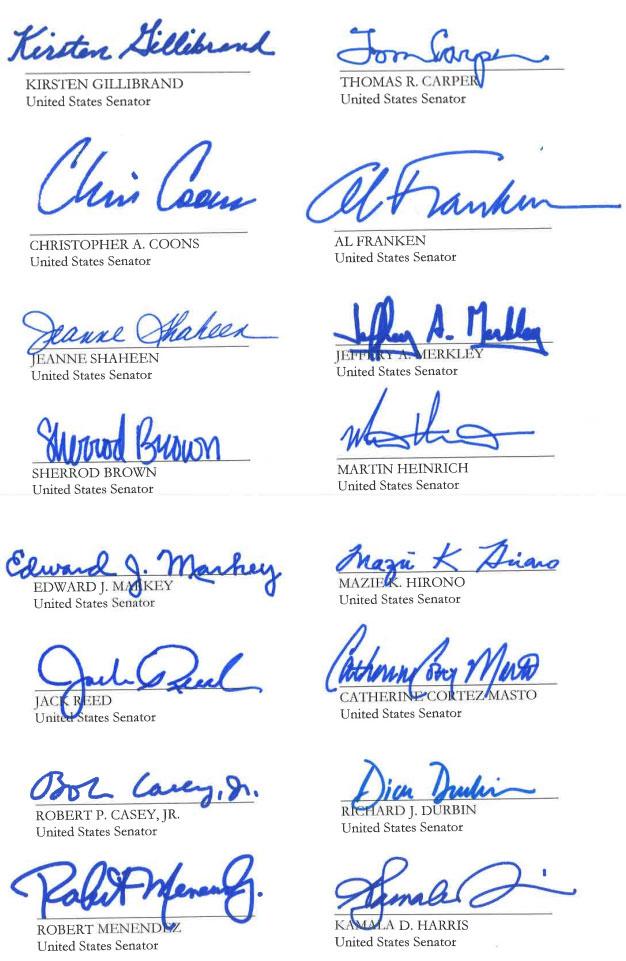
Senators Durbin and Gillibrand were joined by Senators Tom Carper (D-DE), Chris Coons (D-DE), Al Franken (D-MN), Jeanne Shaheen (D-NH), Jeff Merkley (D-OR), Sherrod Brown (D-OH), Martin Heinrich (D-NM), Ed Markey (D-MA), Mazie Hirono (D-HI), Jack Reed (D-RI), Catherine Cortez Masto (D-NV), Bob Casey (D-PA), Bob Menendez (D-NJ), and Kamala Harris (D-CA).
The full text of the letter is here and below:
The Honorable John F. Kelly
Secretary of Homeland Security
Department of Homeland Security
3801 Nebraska Avenue, NW
Washington, D.C. 20528
The Honorable Tom Price
Secretary of Health and Human Services
Department of Health and Human Services
200 Independence Avenue, SW
Washington, D.C. 20201
Dear Secretary Kelly and Secretary Price:
We write regarding the recent uptick in immigration enforcement actions across the country pursuant to President Trump’s policy directives. We are particularly concerned about the impact of such policies on vulnerable people, including the children of deported parents. More than 5,100 children enter the child welfare system each year because of the deportation or detention of their parents. These children are United States citizens, and the deportation of their parents leaves them vulnerable in myriad ways.
As you know, separation from a parent can cause significant negative mental health effects in children. Studies have shown that children who experience these types of traumatic events can suffer from symptoms of anxiety and post-traumatic stress disorder, have poorer behavioral and educational outcomes, and experience higher rates of poverty and food insecurity. Abruptly separating from parents is a highly destabilizing, traumatic experience for children, and one that carries long term consequences such as feelings of loss and grief, economic hardship, and increased risk of neglect and abuse. Additionally, as parents and children are separated, more youth are entering into the child welfare system – a system that is already straining to meet the needs of the many children it serves.
We therefore seek answers to the following questions, and would be grateful for your response within 30 days:
- How many children have entered the child welfare system and been removed from their parents’ care as a result of their parents being deported since January 2015?
- Of these children, please provide data on the type of placements, i.e. foster families, kinship care, or congregate care placement. For those children placed with kin families, what types of trauma-informed supportive services are in place to ensure that these placements are stable and children can thrive?
- What is the estimated financial cost to taxpayers to support U.S. citizen children of deported parents while they are in foster care? Please provide all available data since January 2015, to include an aggregate number and the average cost per child per day, and the average length of stay in foster care.
- What procedures are in place to screen individuals who are in the process of deportation to identify whether they are parents?
- What is your policy when making an arrest of a parent in terms of ensuring continuity of care for minor children?
- What is Department of Homeland Security’s policy regarding contacting local child welfare agencies and what is your protocol when the agency detains an individual and children are in the home without a caretaker?
- What policies are in place to protect the children’s interests in these proceedings?
- What are your agencies doing to ensure that parents in deportation proceedings can meaningfully participate in resultant child welfare cases, and visit with their children?
- Is there a plan to increase federal funding through DHS to support local departments of social services across the country as they experience an increase in their foster care responsibility as a result of new DHS policy?
If the data requested in this letter are not available, we would like to request that your agencies start maintaining them. This information is critical for identifying children in need of support and illuminating potential unintended consequences of immigration policies.
Thank you for your attention to this issue. We look forward to hearing from you soon.
Sincerely,
More like this:



- Most Popular



- Top Stories


- Most Recent


- Sign In
- Home
- Video
- News
-
Weather
 Sponsored by Michael Ryan Exteriors - Roofing Professionals
 - Sports
- Obits
- Events
- Radio
- AP News
- Shop Local
- Classifieds
- Autos
- Real Estate
- Directory
Get the RiverBender App


Follow Us
Copyright © 2026 RiverBender.com All rights reserved.
primary