


Recreational marijuana? Not so fast, say local officials


ALTON - People across the state have been paying close attention to Illinois General Assembly House Bill 2353 - a.k.a. the bill to end cannabis prohibition throughout the state.
Get The Latest News!
Don't miss our top stories and need-to-know news everyday in your inbox.
While many are celebrating what they see to be an end to a prohibition of a non-violent crime, some local officials are pushing the brakes in the interest of both public safety and state priorities. Senator Bill Haine (D-Alton) said he was alerted to the bill like most people - through major media coverage. He said, after reading the bill, he is against the legislation, saying there are bigger issues with which the State of Illinois should be concerned, mostly working through a balanced budget with current Illinois Governor Bruce Rauner (R).
"I am not in favor of it," Haine said. "I think we should work on seeing how our medical marijuana program works for the people before we move to recreational usage. We have other problems we have to deal with, and I don't see this being a reasonable avenue at this time. I don't think it would be good to pursue, especially when we have bigger problems to deal with, like getting the governor to negotiate with us on a budget - a balanced budget. I just don't think it would be good public policy at this time."
Madison County States Attorney Tom Gibbons said he would only be in favor of such legislation if it tackled both the "increasingly violent nature" of the current black market marijuana trade, and worked to ensure the marijuana under state control was free of chemicals, which he said have been used to lace marijuana on the black market.
"The illegal marijuana trade has become increasingly violent over the last several years," Gibbons said in an SMS. "We have also seen marijuana (and synthetic pot) laced with very dangerous chemicals. Both of these have resulted in serious injury or death of far too many young people from our community. If the legislature decides to legalize marijuana, I hope they proceed very cautiously and only do so in a way that eliminates the violent drug trade and ensures that people aren't getting poisoned. Legislation that creates a legal regulated distribution system would, at least, help cut down these two serious issues we are currently facing."
Alton Police Chief Jake Simmons said the Alton Police Department had no comment regarding the proposed legislation, but said his department would enforce any law passed from the legislature.
According to the bill, the following regulations will be in place for legalization of marijuana in Illinois:
- Individuals will have to show proof of age before purchasing cannabis
- Selling, distributing or transferring cannabis to minors and other individuals under 21 years of age shall remain illegal.
- Driving under the influence of cannabis shall remain illegal
- Legitimate, taxpaying business people, and not criminal actors, will conduct sales of cannabis
- Cannabis sold in this state will be tested, labeled and subject to additional regulations to ensure that consumers are informed and protected.
The bill also ensures hemp will be treated differently than plants with high delta-nine tetrahydrocannabinol (THC) concentrations. THC is the active chemical in marijuana, which gives the feeling of being "high" when exposed to heat, such as through smoking or edibles.
If it passes, Illinois residents will be issued the following cannabis regulations
- State residents may not have more than 28 grams of cannabis, and no more than five grams of which can be concentrated cannabis (such as refined hash oil, which can have as much as 98 percent THC content and is smoked through a method known as "dabbing").
- State residents may have as many as five grams of concentrated cannabis.
- Any additional cannabis produced by an individual's cannabis plants, provided that any amount is in excess of 28 grams must be possessed in the same secure facility in which the plants were cultivated.
People visiting Illinois, who are not residents would be allowed to possess no more than 14 grams of cannabis, including as much as two grams of concentrated cannabis.
Cannabis usage may also not take place in a public place. Anyone violating this statute would be fined as much as $100. A person may also not consume cannabis while driving a motor vehicle, boat, vessel, aircraft or other motorized device used for transportation. Penalties for this would be a fine of as much as $200 as well as a six month driver's license suspension for the first time offense.
The legislation would also tax marijuana at a wholesale rate of $50 an ounce, on top of the state's 6.25 percent sales tax.
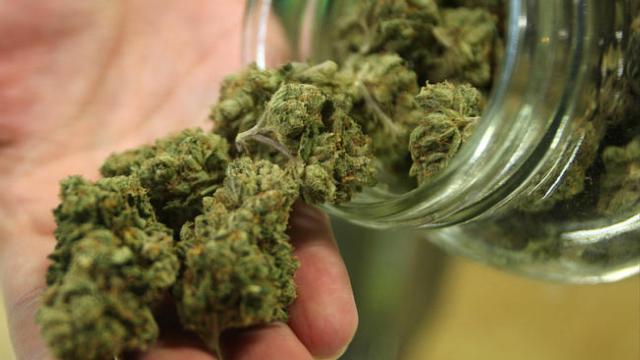
Weed Facts
According to www.drugabuse.gov, the government's data center for drug abuse issues, THC from marijuana passes from the lungs into the bloodstream quickly after smoking. The blood carries the THC to the bran and other organs throughout the body. THC is absorbed much more slowly when an individual eats or drinks it. In that case, the feelings take as long as an hour (so be careful. It will get you).
"THC acts on specific brain cell receptors that ordinarily react to natural THC-like chemicals, which play a role in normal brain development and function," the site says. "Marijuana overactivates parts of the brain that contain the highest number of these receptors. This causes the high that people feel."
Other effects of marijuana highs include:
- Altered senses (seeing brighter colors)
- Altered sense of time
- Changes in mood
- Impaired body movement
- Difficulty with thinking and problem solving
- Impaired memory
While some weed smokers may experience paranoia, heart palpitations and difficulty breathing, these are most likely due to anxiety caused from being high. Long term usage of marijuana has been known to worsen these side effects as well as harm both memory and IQ points, according to a New Zealand study of people who had chronic marijuana usage as teenagers.
According to an article from metro.co.uk, an individual would have to eat as much as 22 kg of marijuana or smoke as many as 680 kg of weed for it to kill him or her. This is compared to 13 shots of alcohol, six liters of water or 70 cups of coffee, which are the fatal doses of each - meaning it is nearly impossible, and would be very expensive, to die from marijuana alone.
That being said, driving while impaired is dangerous to both the driver and everyone else on the road, so if the bill does pass, the same rules would (and should) apply for marijuana as alcohol.
What is your experience with marijuana usage?
More like this:



- Most Popular



- Top Stories


- Most Recent


- Sign In
- Home
- Video
- News
-
Weather
 Sponsored by Michael Ryan Exteriors - Roofing Professionals
 - Sports
- Obits
- Events
- Radio
- AP News
- Shop Local
- Classifieds
- Autos
- Real Estate
- Directory
Get the RiverBender App


Follow Us
Copyright © 2026 RiverBender.com All rights reserved.
primary