This Day in History: October 28 Marks Dedication of Statue of Liberty
From the Cuban Missile Crisis and the Statue of Liberty’s dedication to milestones in independence, science and sport, October 28 has marked turning points across centuries.
This Day in History: October 28, 2026
Major Historical Events
1962: An agreement brings the Cuban Missile Crisis toward an end
On October 28, 1962, Soviet leader Nikita Khrushchev announced that the Soviet Union would dismantle its nuclear missile installations in Cuba. His decision, following negotiations with U.S. President John F. Kennedy’s administration, brought the most dangerous phase of the Cuban Missile Crisis to an end. For nearly two weeks, the confrontation had raised the possibility of nuclear war between the United States and the Soviet Union.
The agreement involved commitments on both sides. Washington publicly promised not to invade Cuba and privately agreed to remove American Jupiter missiles from Turkey. The U.S. naval quarantine remained in place until November, while further arrangements were settled. Cuba’s government, excluded from the central negotiations, objected to aspects of the settlement.
Get The Latest News!
Don't miss our top stories and need-to-know news everyday in your inbox.
The crisis mattered immediately because it reduced the risk of a catastrophic war. Its lasting importance lies in what it revealed about nuclear weapons, miscalculation, and communication. It helped lead to a direct Washington–Moscow communications link and gave new urgency to arms-control efforts.
The wider history of October 28 reaches back many centuries. Following that central anniversary, the events below trace the date’s other milestones in chronological order.
312: Constantine wins the Battle of the Milvian Bridge
Near Rome, Constantine defeated his rival Maxentius in a struggle for control of the western Roman Empire. Maxentius died during the battle, leaving Constantine the dominant ruler in the West.
Christian accounts later connected the victory with a religious vision experienced by Constantine, although the details differ among sources. His subsequent support for Christianity helped transform its position within the empire. The battle did not make Christianity Rome’s official religion, but it marked an important stage in the relationship between imperial government and the Christian church.
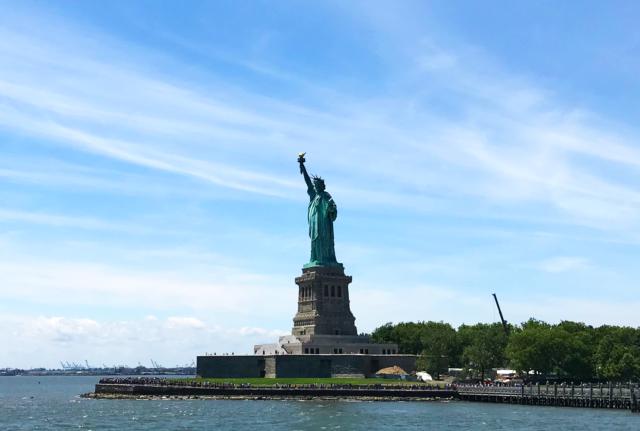
1886: The Statue of Liberty is dedicated
New York Harbor hosted the dedication of the Statue of Liberty, a gift from France to the United States. Designed by sculptor Frédéric Auguste Bartholdi, with an internal structure developed by Gustave Eiffel’s engineering firm, the monument celebrated liberty and the relationship between the two countries.
Its familiar association with immigration developed over time, especially through Emma Lazarus’s poem “The New Colossus,” placed on the pedestal in 1903. The statue became both a recognizable work of public art and a symbol of the hopes surrounding arrival in a new country.
1918: Czechoslovak independence is proclaimed
As Austria-Hungary broke apart near the end of World War I, leaders in Prague proclaimed an independent Czechoslovak state. Their action followed years of organizing by Czech and Slovak independence advocates, both at home and abroad.
The new republic brought together territories with Czech, Slovak, German, Hungarian, Ruthenian, and other populations. It became an important parliamentary democracy in interwar Central Europe, while also facing disputes over borders and minority rights. October 28 remains a national holiday in the Czech Republic.
1928: Indonesian youth affirm a shared national identity
At a youth congress in Batavia, now Jakarta, delegates affirmed what became known as the Youth Pledge: one motherland, Indonesia; one nation, the Indonesian nation; and a shared language, Indonesian.
The declaration emerged under Dutch colonial rule, when the archipelago contained many regional, linguistic, and religious communities. It strengthened the idea that those communities could belong to a common national movement. During the congress, “Indonesia Raya,” later the national anthem, was introduced through an instrumental performance.
1940: Greece rejects an Italian ultimatum
Italy demanded that Greece permit Italian forces to occupy strategic locations in the country. Greek prime minister Ioannis Metaxas rejected the ultimatum, and Italian troops invaded from Albania.
Greek forces resisted and pushed the Italians back into Albania before Germany intervened in 1941. The anniversary became known as Ohi Day, from the Greek word for “no.” It commemorates the rejection of the ultimatum and the resistance that followed, rather than an immediate end to the conflict.
1965: The Catholic Church issues Nostra aetate
Pope Paul VI promulgated Nostra aetate, a declaration of the Second Vatican Council addressing the Catholic Church’s relationship with non-Christian religions.
The document encouraged dialogue and recognized spiritual and moral values in other faith traditions. Its discussion of Judaism rejected the idea that responsibility for Jesus’s death could be assigned collectively to all Jews, either then or afterward, and condemned antisemitism. It became a major reference point for Catholic interfaith relations.
1971: Britain launches the Prospero satellite
A British Black Arrow rocket placed the Prospero satellite into orbit from Woomera, Australia. The mission made the United Kingdom one of the few countries to launch a satellite using a domestically developed rocket.
Prospero carried experiments intended to test spacecraft components. Despite the successful flight, the government had already decided to cancel Black Arrow. The launch therefore demonstrated a national technical capability while also marking the end of that particular launch program.
2018: Lewis Hamilton secures a fifth world title
At the Mexican Grand Prix, British driver Lewis Hamilton finished fourth and secured his fifth Formula One drivers’ championship. Max Verstappen won the race.
Hamilton’s title brought him level with Argentine champion Juan Manuel Fangio’s career total. It connected two very different eras of motor racing, separated by major changes in vehicle design, safety standards, and the sport’s international reach.
Notable Births
Jigoro Kano — 1860
Born in what is now Kobe, Japan, Jigoro Kano founded Kodokan judo in 1882. He adapted techniques from older martial traditions into a system emphasizing training, discipline, and education. His work helped turn judo into an international sport, and he became the first Asian member of the International Olympic Committee.
Edith Head — 1897
American costume designer Edith Head helped shape the appearance of Hollywood films across several decades. Her work supported characterization as well as visual style, and she won eight competitive Academy Awards for costume design.
Jonas Salk — 1914
Physician and researcher Jonas Salk led the team that developed the first widely used inactivated polio vaccine. Announced as safe and effective in 1955, it became a central tool in reducing a disease that had caused paralysis and widespread fear.
Bill Gates — 1955
Born in Seattle, Bill Gates co-founded Microsoft with Paul Allen. The company played a major role in the spread of personal computing through its operating systems and software. Gates later became prominent in philanthropy, particularly global health.
Notable Deaths
John Locke — 1704
English philosopher John Locke wrote influential works on knowledge, religious toleration, and government. His arguments about natural rights and government by consent helped shape later constitutional thought, although the societies that adopted such ideas often applied them unevenly.
Max Müller — 1900
German-born scholar Max Müller spent much of his career at Oxford studying language, Sanskrit literature, and religion. He helped make major Asian religious texts available to European readers through the Sacred Books of the East series.
Ted Hughes — 1998
British poet Ted Hughes, Poet Laureate from 1984 until his death, was known for forceful language and close attention to animals and the natural world. His poetry, translations, and children’s books gave him a broad literary influence.
October 28 brings together decisions made under extreme pressure, movements toward shared identity, and achievements built through years of patient work.
More like this:



- Most Popular



- Top Stories


- Most Recent