


This Day in History: October 6 Sees Beginning of Yom Kippur War and Opening of the Moulin Rouge
From the Yom Kippur War and the opening of the Moulin Rouge to scientific discoveries and political struggles, October 6 marks a range of historical milestones.
On October 6, 1973, Egypt and Syria launched coordinated attacks against Israeli forces in the Sinai Peninsula and the Golan Heights, beginning the conflict widely known as the Yom Kippur War or October War. Both territories had been captured by Israel in the 1967 war. The attack came during Yom Kippur, the holiest day in Judaism, and during the Muslim month of Ramadan. Fighting caused heavy losses, drew the United States and Soviet Union into urgent diplomacy, and helped set the stage for an oil embargo that affected economies worldwide. The war also changed the course of Middle Eastern diplomacy, contributing to negotiations that eventually produced the 1979 Egypt–Israel peace treaty.
Major Historical Events
1600: An early opera reaches the stage
Florence hosted the first performance of Jacopo Peri’s Euridice on October 6, during celebrations surrounding the marriage of Maria de’ Medici and King Henry IV of France. With a text by Ottavio Rinuccini, the work grew from experiments in combining music and drama inspired by ancient Greek theater.
Although it was not the first opera ever composed, Euridice is generally recognized as the earliest opera whose music survives substantially complete. Its performance helped establish a form of storytelling that would spread through Europe and eventually become a worldwide performing tradition.
1683: German settlers arrive in Pennsylvania
Thirteen families from Krefeld, in what is now Germany, arrived in Philadelphia on this date. They helped establish Germantown, a settlement that became an important center of German-speaking life in colonial North America.
Religious freedom and economic opportunity attracted many such migrants. The arrival is now commemorated through German-American Day in the United States. Germantown also became associated with an early challenge to slavery: in 1688, four residents submitted an antislavery petition to their Quaker community.
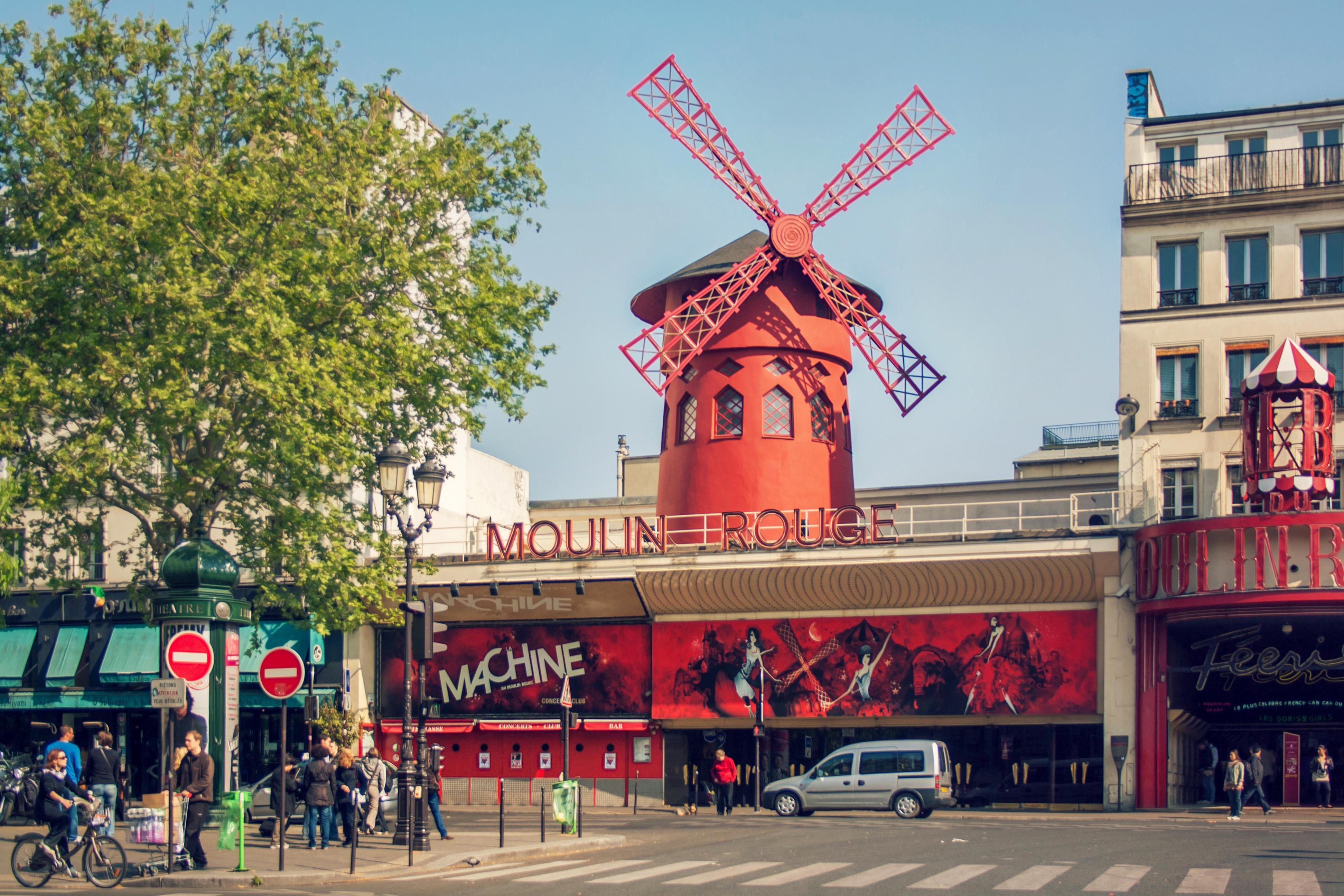
1889: The Moulin Rouge opens in Paris
The Moulin Rouge opened in the Montmartre district of Paris, offering dance, music, and variety entertainment. Its red windmill became a recognizable symbol of the city’s nightlife.
The venue helped popularize the French cancan and attracted audiences from different social backgrounds. Posters by artists such as Henri de Toulouse-Lautrec linked its performers with the developing world of commercial graphic art. Its history reflects the growing connection between urban entertainment, tourism, and mass publicity.
1927: The Jazz Singer accelerates the transition to sound
Warner Bros. premiered The Jazz Singer in New York on October 6. Starring Al Jolson, it combined mostly silent storytelling with synchronized songs and short passages of spoken dialogue.
Earlier films had already experimented with recorded sound, so this was not the invention of talking pictures. Its commercial success, however, helped persuade studios and theaters to invest in sound technology. The change transformed filmmaking and performers’ careers. The film also included blackface performance, a practice rooted in racial caricature that forms an important part of its historical context.
1973: War reshapes regional diplomacy
Egyptian forces crossed the Suez Canal while Syrian forces attacked in the Golan Heights. Their initial advances challenged Israeli assumptions about military security, before Israeli counteroffensives changed the battlefield situation.
United Nations ceasefire efforts and negotiations eventually ended the fighting. Egypt’s President Anwar Sadat later pursued direct diplomacy with Israel, while Syria followed a different course. The war’s consequences extended beyond the region through superpower tensions, energy shortages, and changes in international economic policy.
1976: Students are attacked at Thammasat University
Security forces and right-wing groups attacked students at Thammasat University in Bangkok on October 6. The students had been protesting the return of former military ruler Thanom Kittikachorn, whose departure in 1973 had followed a major democracy movement.
The official death toll was 46, although higher estimates have been reported. A military coup followed that evening. The massacre ended a brief period of more open political activity and remains a major event in Thailand’s history of student organizing, military rule, and struggles over public memory.
1981: Anwar Sadat is assassinated
Egyptian President Anwar Sadat was killed during a military parade in Cairo commemorating the 1973 war. The attackers were Islamist militants, including members of the armed forces.
Sadat had faced opposition over several policies, including his peace agreement with Israel and repression of domestic critics. Vice President Hosni Mubarak succeeded him. Despite the assassination, the Egypt–Israel treaty remained in force, preserving a major change in relations between the two countries.
1990: Ulysses begins its journey toward the Sun’s poles
The space shuttle Discovery launched the Ulysses spacecraft, a joint mission of the European Space Agency and NASA. Rather than traveling directly over the Sun’s poles, Ulysses used Jupiter’s gravity to redirect its orbit.
The mission studied the solar wind and the Sun’s magnetic environment from viewpoints unavailable to spacecraft orbiting near the planetary plane. Its observations improved understanding of how solar activity shapes conditions across the solar system.
1995: A planet around a Sun-like star is announced
Astronomers Michel Mayor and Didier Queloz announced the discovery of 51 Pegasi b, the first confirmed planet orbiting a Sun-like star beyond our solar system. They detected it through small changes in the star’s motion caused by the planet’s gravitational pull.
The discovery surprised researchers because the giant planet orbited extremely close to its star. It helped establish exoplanet research as a rapidly expanding field and showed that planetary systems could differ greatly from our own.
2010: Instagram launches
Instagram became publicly available on October 6, initially as an iPhone application. Its simple photo-sharing tools and image filters encouraged users to communicate through pictures.
The service became influential in photography, advertising, entertainment, and everyday communication. Its growth illustrates how smartphones changed both the production and distribution of visual media.
Notable Births
Matteo Ricci, born in 1552, was an Italian Jesuit missionary who worked in China. His knowledge of Chinese language and traditions, along with his mathematical and geographical work, made him an important figure in exchanges between Chinese and European scholars.
Born in 1846, American inventor and industrialist George Westinghouse developed railway air-brake technology and promoted alternating-current electrical systems. His work helped make rail travel safer and supported the expansion of electrical power networks.
The architect Le Corbusier was born in Switzerland in 1887. His buildings and writings influenced modern architecture and urban planning internationally, especially through functional design, reinforced concrete, and proposals for reorganizing cities.
Norwegian explorer Thor Heyerdahl, born in 1914, became famous for the 1947 Kon-Tiki raft expedition across the Pacific. The voyage demonstrated that such travel was possible, although it did not establish his broader theories about ancient migration.
Fannie Lou Hamer was born in Mississippi in 1917. Her voting-rights work and role in the Mississippi Freedom Democratic Party brought national attention to the exclusion and violence faced by Black Americans seeking political participation.
Notable Deaths
Alfred, Lord Tennyson died in 1892. As Britain’s poet laureate, he became one of the best-known writers of the Victorian era, exploring grief, faith, change, and public duty.
American poet Elizabeth Bishop died in 1979. Her carefully observed poems, shaped partly by years spent in Brazil, earned lasting recognition for their precision and treatment of travel, memory, and loss.
Portuguese singer Amália Rodrigues died in 1999. Her performances brought fado to international audiences and helped make the musical tradition a widely recognized expression of Portuguese culture.
October 6 brings together stories of conflict, migration, creative expression, scientific discovery, and demands for participation.
More like this:



- Most Popular



- Top Stories



- Most Recent


