
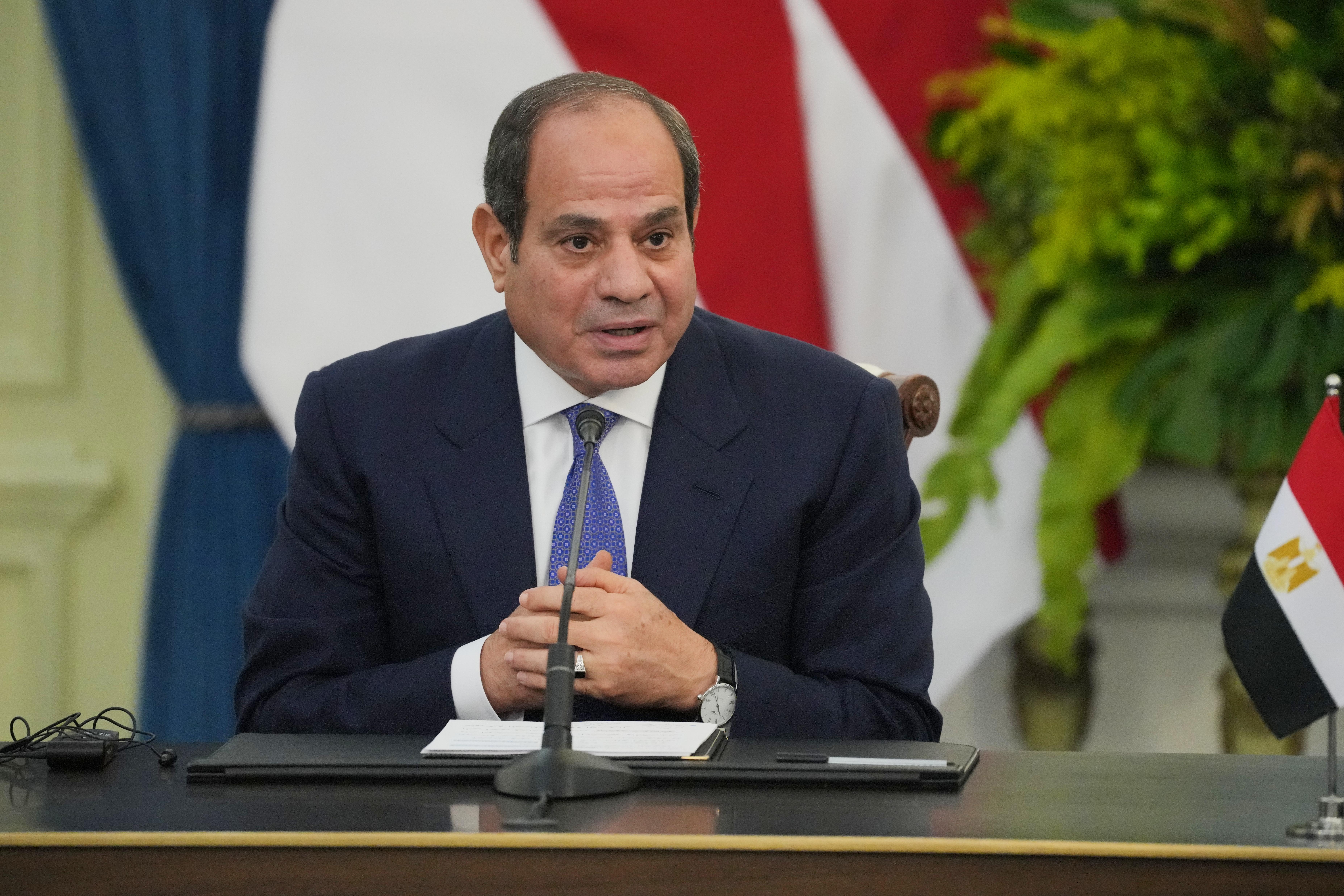
CAIRO (AP) — Egypt’s parliament on Monday voted to authorize President Abdel-Fattah el-Sissi to provide Saudi Arabia with military support in defending the kingdom against attacks by Iran-backed Houthi rebels.
The parliament said in a statement that the vote was meant to give el-Sissi authorization to take necessary measures to back Saudi Arabia in the defense of its territory and sovereignty against an external “aggression.”
Get The Latest News!
Don't miss our top stories and need-to-know news everyday in your inbox.
The parliament didn't provide a breakdown of the closed-door vote, but the chamber is overwhelmingly dominated by pro-government lawmakers.
The government didn’t give details about the support, prompting lawmakers to question the nature and extent of the proposed assistance. A regional official, briefed on the matter, said that Egypt will deploy air defense systems and aircraft to help repel missiles and drones fired at Saudi Arabia.
The Egyptian support is defensive in nature and won’t include any ground troops in Yemen, the official said on condition of anonymity because he wasn’t authorized to speak to reporters.
The vote, which had been scheduled for last week, was delayed after two days of deliberations because of growing wariness among Egyptians concerned about an intervention in Yemen’s long-running conflict. Because the debates weren't open, it wasn't immediately clear how the discussions went.
Egypt’s highest security body pledged in a meeting earlier this month to provide “all necessary and possible forms of support” to Saudi Arabia to defend “its security and stability, safeguard its resources and territorial integrity, and protect Islamic holy sites.”
In its meeting, chaired by el-Sissi, the National Defense Council also said that Egypt would increase its diplomatic efforts to find a settlement to the conflict.
Egypt “will carry out any measure to protect Saudi Arabia,” el-Sissi said earlier this month. “I’m not speaking about fighting anyone or attacking anyone. I’m speaking only for defense.”
Saudi Arabia is one of Egypt’s main financial backers, providing the country with billions of dollars in financial aid and investments, particularly since el-Sissi came to power following the overthrow of President Mohammed Morsi, a Muslim Brotherhood leader, in 2013. Remittances from Egyptians working in Saudi Arabia are also a major source of foreign currency.
The opposition Egyptian Social Democratic Party announced that its 11-member parliamentary bloc would abstain from voting, citing insufficient information about the mission’s objectives, scope, duration and costs, as well as the risks to Egyptian troops. The party called for prioritizing diplomacy to avert open-ended military commitments.
Egypt's president sought to reassure the public that the country wouldn't attack Yemen, and that the military support is limited to defending Saudi territory.
“I have heard a great deal of talk suggesting that we are preparing to launch an attack on Yemen, or something to that effect. That is certainly not the case,” he said in comments last week.
“We have not engaged in any cooperation aimed at conducting combat operations beyond the borders (of the countries with which we cooperate),” el-Sissi said. “Our focus is on the defense of the kingdom’s territory and its borders.”
The announcement of support for Saudi Arabia has evoked dark memories of Egypt’s involvement in the civil war in Yemen in the 1960s, pitting royalist supporters of the Mutawakkilite Kingdom of Yemen against the Yemen Arab Republic.
That war began in 1962 when army commander Gen. Abdullah al-Sallal launched a coup against the newly-crowned King Muhammad al-Badr, declaring North Yemen a republic.
Egypt and Saudi Arabia backed opposite sides: Saudi Arabia and the United Kingdom supported royalist forces, while Egypt and the Soviet Union backed the republican troops.
Then Egyptian President Gamal Abdel Nasser deployed tens of thousands of troops to North Yemen in support of his ally, al-Sallal, starting a decadelong military intervention in the country.
The 1960s intervention in Yemen was seen as “one of the low points” of Nasser’s presidency and widely regarded as one of the main causes of the defeat by Israel in the 1967 Six-Day War, because of the strain it exerted on the Egyptian military and economy, according to the state-run Al-Ahram daily.
In 2015, Egypt sent naval vessels to the Red Sea off Yemen to support the Saudi-led coalition operating against the rebels at the height of the earlier phase of the war. It didn't deploy ground troops.
___
Fatma Khaled contributed to this report.