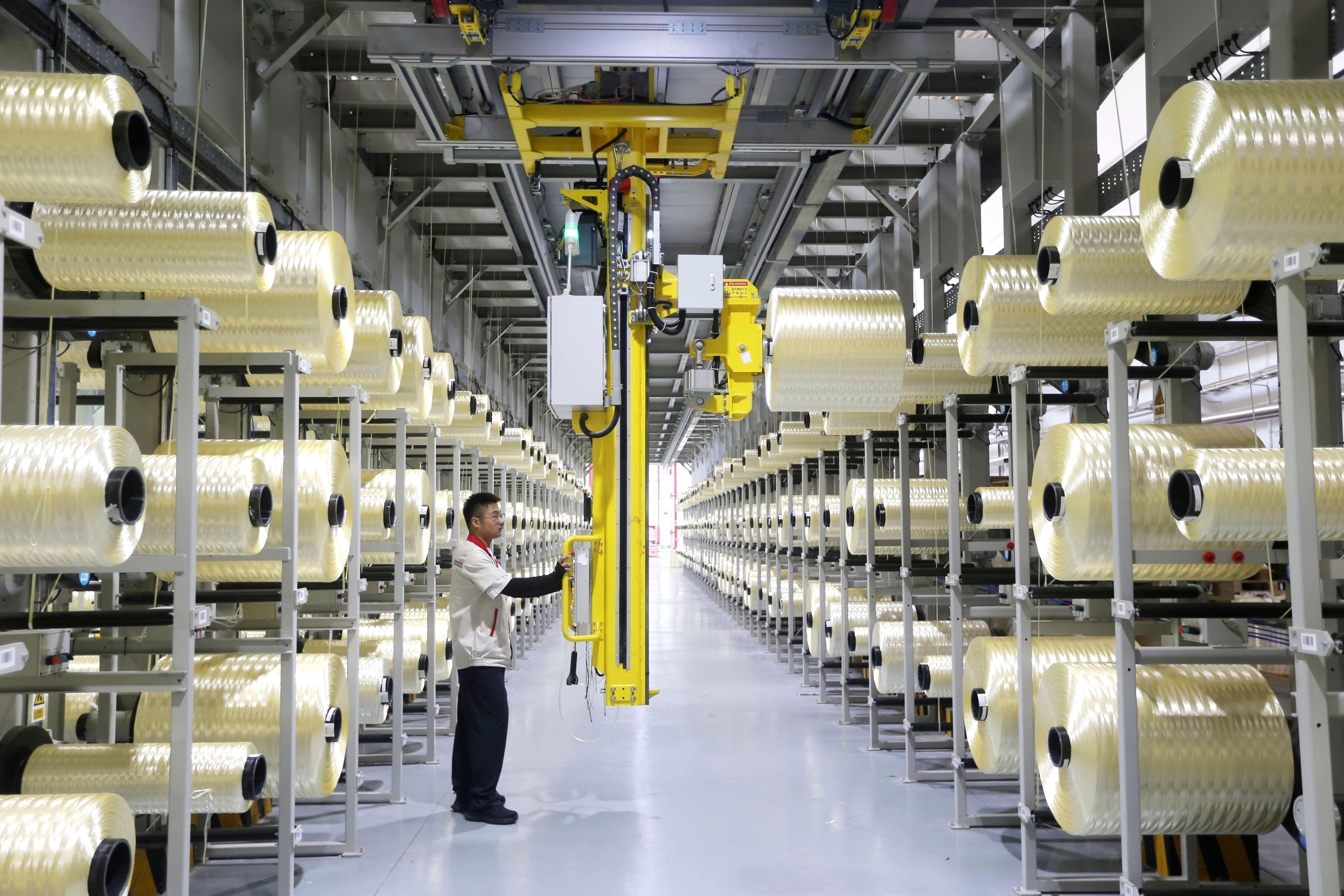
BEIJING (AP) — China’s factory activity contracted in October as new export orders softened, reversing the previous month's rebound.
The world’s second-biggest economy has been facing pressure from trading partners to rebalance trade as its trade surplus with many countries balloons.
Get The Latest News!
Don't miss our top stories and need-to-know news everyday in your inbox.
Data released on Saturday by the National Bureau of Statistics showed that China’s official manufacturing purchasing managers’ index fell to 49.3 in October, compared with 50.1 in September and 49.8 in August.
The PMI is based on a monthly survey of companies and measured from 0 to 100. Readings below 50 indicate contraction while readings above 50 reflect expansion.
Several key subindexes were also in contraction territory in October, including new export orders, which fell to 48.7 from 50.0 in September. The subindex on production dropped to 49.8, from 51.7.
Chinese companies have been shipping more goods abroad to find buyers at a time of weakened domestic demand, which is being dragged down by China’s yearslong property sector downturn.
But an increasing number of China’s trading partners are complaining about growing trade deficits with China, arguing that an influx of cheaper Chinese goods has hurt the competitiveness of their domestic industries.
The 27-nation European Union has been highlighting what it says is an unsustainable trade deficit with China that hit $1.1 billion a day in 2025. The EU has taken measures to rebalance trade including striking a deal with Beijing to cap the imports of Chinese hybrid vehicles.
China has been exporting more to trading partners in Europe, Southeast Asia and Latin America since the U.S. imposed higher tariffs last year.
In a speech Thursday at Beijing University, Germany’s ?President Frank-Walter Steinmeier said that while it’s “understandable that China wants to protect its economy against external shocks and negative influences,” that must not mean making other countries increasingly dependent on China.
Steinmeier, who was on a visit to China, met Chinese President Xi Jinping and Premier Li Qiang on Friday. Li told Steinmeier that China is willing to import more high-quality products from Germany.
Some economists have forecast that China’s exports are likely to remain robust for the rest of the year and that its overall trade surplus in 2026 could surpass last year’s record $1.2 trillion.
Trade is also likely to be on the agenda during U.S. President Donald Trump's expected meeting with Xi in mid-November on the sidelines of the Asia-Pacific Economic Cooperation summit in Shenzhen, China.